
 Need help?
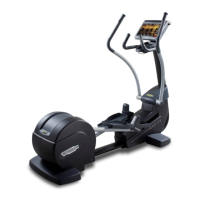
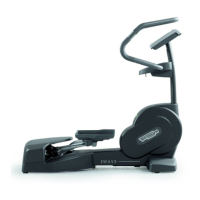
Do you have a question about the Technogym WAVE EXCITE+ and is the answer not in the manual?
Details the manual's purpose for qualified technicians and the importance of thorough knowledge.
Provides steps for planning repair procedures, including diagnosis and rational planning.
Outlines essential rules for performing repair procedures, emphasizing care and proper parts.
Details the alphanumeric structure of product codes and key to values for variants.
Explains the 14-character alphanumeric structure of the serial number.
Lists available color options for the machine's frame and guards.
Compares key characteristics and features across different machine models.
Provides dimensions and weight specifications for the machine.
Details packing dimensions for shipping and space required for operation.
Specifies required temperature and humidity conditions for operation and storage.
Lists standards and directives the machine conforms to for safety and emissions.
Introduces wiring diagrams for different machine models.
Illustrates the wiring connections for the 500 model with ARM board.
Illustrates the wiring connections for the 500SP model with ARM board.
Illustrates the wiring connections for the 700 model with ARM board.
Illustrates the wiring connections for the 700SP model with ARM board.
Illustrates the wiring connections for the 700VISIO model with CPU board.
Details cable types and pin-outs, noting color changes may occur.
Provides pin-out and signal details for CBQ cables.
Details specifications and pin-outs for various CU cables.
Details specifications and pin-outs for ELT cables.
Illustrates the overall block diagram of the machine for powered and self-powered versions.
Describes the function and indicator LEDs of LED display boards.
Explains the components and functions of the ARM board for 500/500SP models.
Details the ARM board for 700 models, including its functions and indicator LEDs.
Describes the C-Safe board's communication port for external devices and PC interfacing.
Explains the Dual TGS reader's role in interacting with the Wellness System.
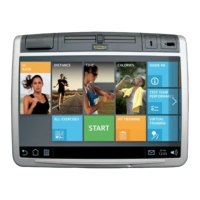
Introduces the Visio Display Board and its primary components.
Details the 700 CPU board, its memory, functions, and LED indicator.
Explains the function of the LCD inverter in powering the display lamps.
Describes the tuner board's function for receiving and managing audio/video signals.
Details the integrated LAN network board for connecting the VISIO device.
Explains the wireless network board for Wi-Fi connectivity.
Describes the board for connecting external audio/video sources and displays.
Details the headphone jack on the display for audio output.
Explains the C-Safe board's function for connecting external devices like PCs.
Describes the USB port for updates and data transfer between VISIO devices.
Lists optional accessories available for the machine.
Details the iPod docking station for storing, powering, and controlling iPods.
Describes the additional USB port for connecting external devices and multimedia playback.
Explains the Dual TGS reader's role in interacting with the Wellness System.
Details the cardio receiver board and its function in managing heart rate signals.
Explains the HR/HS receiver's operation with chest belts and hand sensors.
Describes the HR receiver's function when used with a chest belt transmitter.
Details the brake board's components, functions, and indicator LEDs.
Explains the principle of operation of the eddy current electromagnetic brake.
Describes the magnetic induction sensor that detects the speed of the brake disk.
Explains the role of NTC thermostats in monitoring brake board and winding temperatures.
Describes the power entry module components for powered models.
Explains how the alternator generates voltage for self-powered models.
Details the battery's role and recharging methods in self-powered models.
Describes the socket for connecting an external power supply for battery recharging.
Explains the mechanics and controls of the brake system.
Describes the mechanical components involved in the brake control system.
Illustrates the control block diagram for the brake system.
Details the RS-485 signal, excitation current, and pulses used in brake control.
Details how to connect the machine to a Cardio Theater unit via RJ45.
Explains how to connect the machine to a PC for programming using the RJ45 port.
Describes the monitor plug used for testing the C-Safe port functionality.
Details the differences between VISIO and VISIOWEB and upgrade procedures.
Provides information on upgrade kits for converting LED to VISIO displays.
Lists available accessories like TGS reader, iPod docking station, and USB port.
Outlines requirements for correct machine installation, including surface and environment.
Provides instructions and warnings for moving the machine using dollies or trolleys.
Refers to external documentation for minimum requirements for signal antennas.
Details the step-by-step process for correctly installing the machine.
Guides through the initial power-on and checks for correct machine operation.
Explains how to access the troubleshooting menu for LED models.
Details the procedure to access the configuration menu for 500 models.
Details the procedure to access the configuration menu for 700 models.
Describes the automatic tests for checking machine operation.
Explains the I2C Devices test for communication checks.
Details the LED test for display functionality and buzzer test.
Describes tests for C-Safe, Low Kit, and TGS serial port communications.
Describes manual tests for checking machine operation.
Explains how to perform a manual test of the keyboard functionality.
Explains how to access the troubleshooting menu for Visio models.
Troubleshooting steps for LED models when the display does not illuminate.
Troubleshooting steps for SP models when the display does not illuminate.
Troubleshooting steps when the display does not remain on after exercise stops.
Troubleshooting steps for Visio models when the display does not illuminate.
Troubleshooting for touch screen not working or not calibrated.
Troubleshooting steps for Visio models with no audio sound.
Troubleshooting steps for Visio models with no TV picture.
Troubleshooting steps for Visio models when the radio does not play.
Troubleshooting steps for Visio models when the iPod is not detected or working.
Troubleshooting for the 'Equipment Locked (COM)' error message.
Troubleshooting steps when the machine produces no resistance.
Troubleshooting steps when the machine produces incorrect resistance.
Troubleshooting steps when the speed signal is incorrect.
Troubleshooting steps when the machine fails to read the TGS reader.
General troubleshooting for no heart rate signal.
Troubleshooting for HR/HS receiver (hand sensor) when no heart rate signal is detected.
Troubleshooting for HR/HS receiver (chest belt) when no heart rate signal is detected.
Troubleshooting for HR receiver (chest belt) when no heart rate signal is detected.
Troubleshooting for incorrect telemetric heart rate signals (Chest Belt).
Troubleshooting for incorrect telemetric heart rate signals (Hand Sensor).
Step-by-step guide to disassembling the display for 500/500SP, 700/700SP, and 700VISIO models.
Guide to removing boards and components from the display unit.
Procedure for removing the ARM board and C-Safe board from the LED display.
Instructions for unplugging connectors and removing the ARM board.
Instructions for disconnecting and removing the C-Safe board.
Guide to removing components from the Visio 15" display unit.
Steps for unplugging antenna connectors and removing the wireless board.
Instructions for removing the tuner board, including screws and flat cable.
Details on removing ATSC or ISDB-T tuner boards and dissipater.
Steps for unplugging connectors and removing the LCD inverter board.
Instructions for unplugging connectors and removing the CPU board.
Guide to removing the LCD and touch screen assembly.
Instructions for unplugging the connector and removing the headphone jack.
Steps for unplugging cables and removing the TGS reader and USB port.
Instructions for removing the iPod docking station covering and cable.
Steps for removing the frontal plugs and USB port cover.
Guide to disassembling the keyboard and touch screen components.
Instructions for unplugging the connector and removing the LED keyboard.
Refers to LCD/Touch Screen disassembly for Visio version keyboard removal.
Guide to disassembling the cardio receiver unit.
Steps for removing the HR/HS receiver from its housing.
Instructions for unplugging the connector and removing the HR receiver.
Step-by-step guide to disassembling the handlebar components.
Instructions for removing the sensors and their supports.
Guide to removing various guards and covers from the machine.
Steps for disassembling the upper part of the machine column.
Instructions for removing the brake board box.
Steps for removing the footboards from the machine.
Guide to disassembling the footboard lever belt and its components.
Instructions for disassembling footboards on newer versions (specific serial numbers).
Steps for disassembling the levers tensioning spring and cam.
Instructions for unplugging connectors and removing the brake winding assembly.
Guide to disassembling the secondary shaft group for powered models.
Specific steps for disassembling the secondary shaft group on powered models.
Specific steps for disassembling the secondary shaft group on self-powered models.
Guide to disassembling the primary shaft group and its components.
Instructions for disassembling the belt connecting primary and secondary shafts.
Steps for removing the speed sensor and its support for powered models.
Instructions for removing the power entry module and its cover.
Guide to disassembling the front and rear platform guards.
Instructions for removing the battery for self-powered models.
Procedure for adjusting the belt tension and recommended tension value.
Guide to adjusting the speed sensor position relative to the copper disk.
Instructions for positioning and centering the brake winding support.
Procedure for aligning the belt connecting the primary and secondary shafts.
Guide to adjusting the distance between footboards using the shock absorber.
Details on adjusting the length of tie rods according to specified figures.
Instructions for adjusting the machine's feet to ensure it is level.
Explains how to access and configure user menu settings for 500LED models.
Details how to select the display language for the machine.
Explains how to select between European and Imperial units.
Details how to set the maximum duration for each exercise session.
Explains how to set the maximum pause time for each exercise.
Details how to set the cooldown time for each exercise.
Explains how to set the default age for a generic user.
Details how to set the default weight for a generic user.
Explains how to set the default duration for an exercise session.
Details how to set the default calories for an exercise session.
Explains how to set the default distance for an exercise session.
Details how to enable or disable the use of the TGS reader.
Explains how to disable the keyboard for TGS-only use.
Details how to enable/disable target heart rate modification during exercise.
Explains how to configure custom messages displayed in standby state.
Details how to reset user menu parameters to their default values.
Explains how to format a TGS key for Plug&Play mode operation.
Displays the serial number of the machine.
Explains how to access and configure user menu settings for 700LED models.
Details how to select the display language for 700LED models.
Explains how to select units for distance measurement (KM/MLS).
Details how to set the maximum exercise time for 700LED models.
Explains how to set the pause time for 700LED models.
Details how to set the cooldown time for 700LED models.
Explains how to enable or disable TGS reader for 700LED models.
Details how to disable the keyboard for 700LED models.
Explains how to modify target heart rate during exercise for 700LED models.
Details how to configure custom messages for 700LED models.
Explains how to edit custom messages for 700LED models.
Details how to change languages for custom standby messages on 700LED models.
Explains access to service menu configuration for LED models.
Details accessing service configuration for 500 models.
Details accessing service configuration for 700 models.
Provides access to parameters for modifying lower assembly settings.
Explains how to read parameter values and errors from the low kit memory.
Details how to write displayed parameter values to the low kit.
Explains how to load default parameter values and confirm.
Lists configuration parameters with their units, names, and descriptions.
Explains how to access machine usage data stored in the low kit.
Details how to read machine usage data from the low kit memory.
Explains how to write displayed usage data to the low kit.
Provides descriptions for machine usage data like Life Brake, Life Kit High/Low, KJ, Tot Km.
Explains how to access the machine's error history log.
Details how to read errors stored in the low kit memory.
Explains how to clear the error history in both low and high kit memory.
Describes the COM.Fault counter for serial communication errors.
Explains the information recorded for each error generated by the machine.
Explains how to clear operating data and reset brake board parameters.
Provides direct access to the firmware of the brake board.
Displays the brake board firmware version.
Displays the error code blocking the low kit.
Displays the SW version of the display.
Displays the BOOT version of the display hardware.
Displays the KEY READER VERSION.
Explains how to access the user menu for Visio and VisioWeb devices.
Explains how to access the service menu for Visio and VisioWeb devices.
Lists configuration parameters for Visio models.
Details the electrical safety test procedure, focusing on grounding ring resistance.
Covers checks for transmission, levers, guards, and overall assembly security.
Ensures correct mounting and alignment of transmission and levers systems.
Verifies that all machine guards are properly in place and secured.
Details the procedure for checking machine operation after installation or intervention.
Lists critical components identified by serial number for traceability.
Describes routine maintenance tasks performable by club managers.
Covers daily setup operations and external cleaning procedures.
Details monthly internal cleaning procedures using a vacuum cleaner.
Outlines checks for machine operation, including belt motor, resistance, and heart rate.
Describes maintenance tasks requiring a qualified Technogym technician.
Verifies machine connection, outlet earthing, and earth node connection.
Tests cardio receiver operation using a heart rate monitor or simulator.
Tests hand sensor receiver operation with a heart rate monitor.
Inspects the pedal lever belt for state of wear and calls for service if anomalies found.
Checks for play in ball joints and recommends calling Technogym Service if found.
Inspects rubber components for wear and recommends replacement if evident.
Inspects belts for wear and checks their tension.
Checks for excessive play in the lever and pedal group by shifting body weight.
Verifies operation of keyboard keys, LEDs, buzzer, and Visio touch screen calibration.
Inspects wiring, connectors, fuses, and wires for continuity and isolation.
Lists configuration menus and their corresponding access passwords.
Lists all necessary tools for disassembly, adjustment, and maintenance actions.
 General
| Type | Elliptical Trainer |
|---|---|
| Resistance Levels | 25 |
| Warranty | 2 years |
| Display | LCD |
| Connectivity | Bluetooth |
| Power Requirements | 100-240 V, 50-60 Hz |
| HR Monitoring | Hand Sensors |


 To Next Page