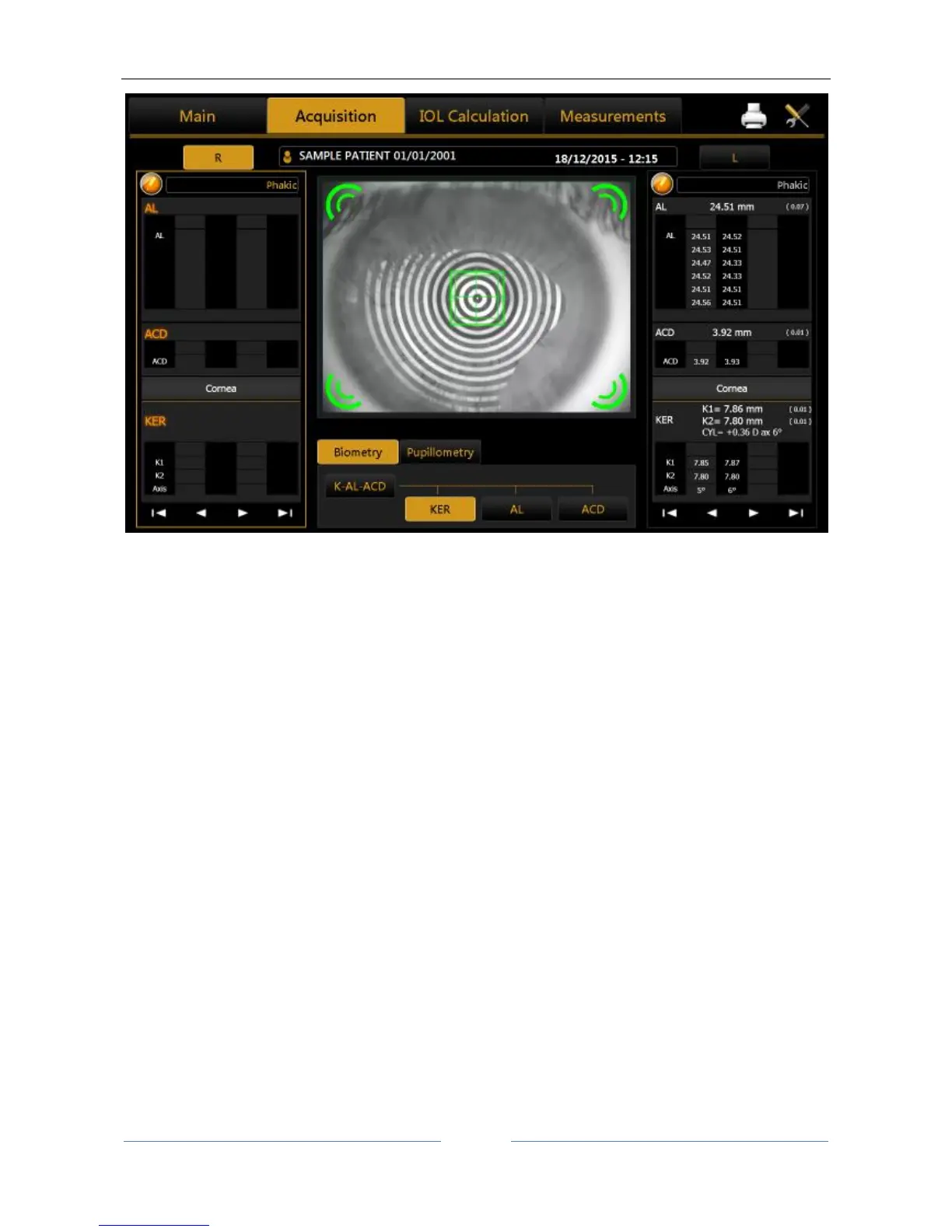
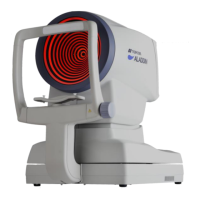
Figure 39
In this mode, the topographic map of the cornea is acquired.
Knowing the distance of the corneal apex, with a precision of microns, at the time of acquisition of the
topographical image, the software applies to each of the 256 zero crossing, identified for each of the 24
RINGS, a correction factor given by the ratio between correct mean value and mean radius of the ring.
Concerning the calculation, the software performs the standard calculation of 6,144 zero crossing points,
identified at the 24 RINGS along the 256 semi-meridian.
In order to increase the measurement precision, interferometry is used to evaluate the corneal distance.
The keratometry data is evaluated in the right column, which is referring to the left eye.
This section has the same interactions as the “K-AL-ACD” acquisition.
However, since it is not possible for the human eye to stay still, the images acquired manually in a range close
to the optimum focus (which is the optimal operating range of the device) can be out-of-focus.


 To Next Page