13.13.4 ANTERIOR CHAMBER DEPTH (ACD)
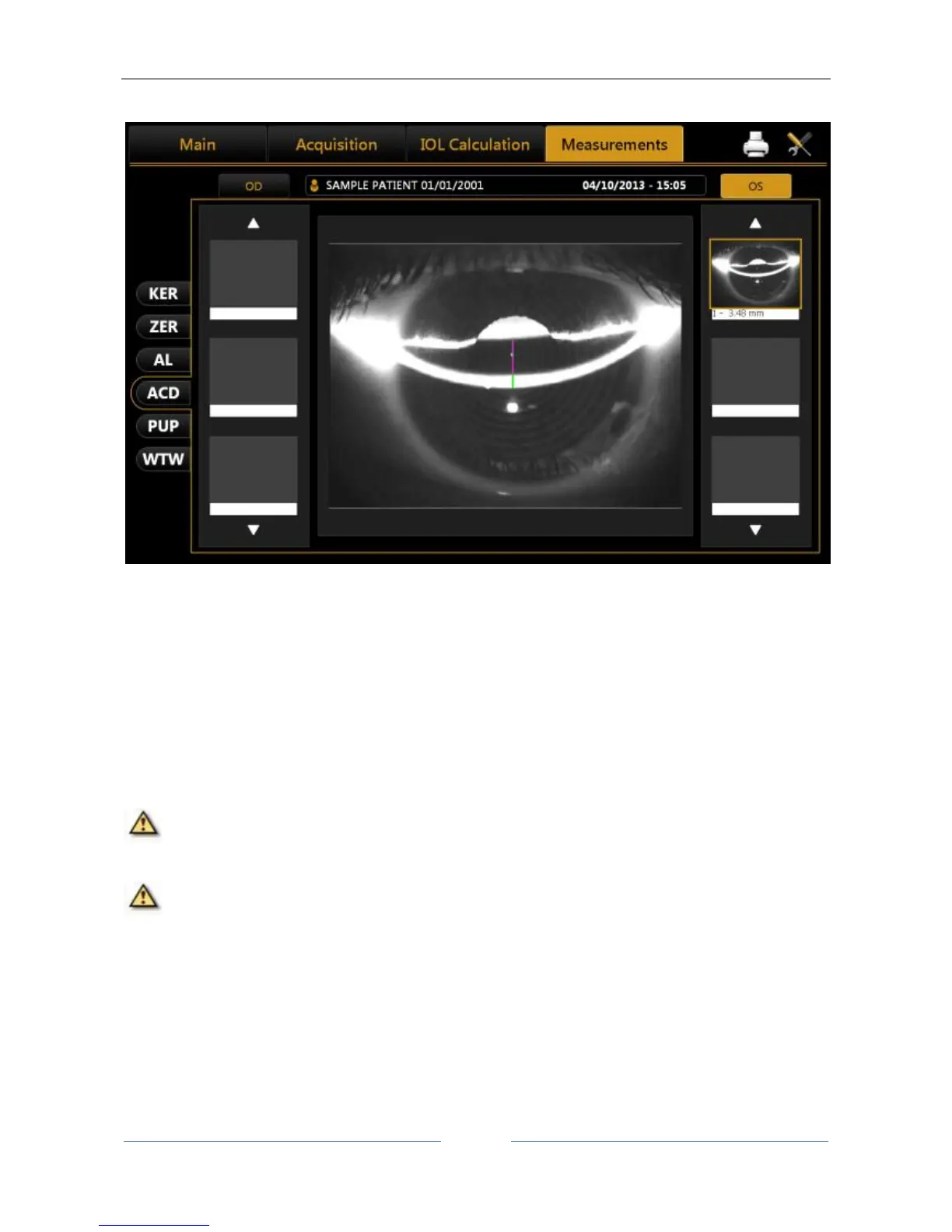
Figure 66
Figure 66 gives an example of ACD (Anterior Chamber Depth) measurement.
Looking at the image in the centre of the screen, you can see that three different reflections are present.
From the bottom, the first reflection is the slit's point of origin and is irrelevant for calculation purposes.
The second half-moon-shaped reflection is the reflection of the light slit on the first corneal surface. The third
reflection is divided into crystalline reflection - you can see that this reflection has a high thickness - and iris
reflection. The latter is also irrelevant for calculation purposes.
As for the axial length, if the instrument does not record good quality reflections, or if the data is inconsistent,
the acquisition is discarded.
Caution should be practised when using the device’s ACD measurement for any given intraocular lens
calculation because of the high variability of this measurement.
The ACD measurement is the distance between corneal epithelium and the crystalline lens surface.
13.13.5 PUPILLOMETRY (PUP)
The pupillometry module allows displaying and analyzing the dynamic and static pupillometry (pupil images
acquired in controlled light conditions).
Normally, if the pupillometry is acquired, the software goes into dynamic mode (Figure 67).


 To Next Page