VEMCO – VR100 Manual 28 May 2018 30
From the Main Screen:
1. Select Monitor by pressing the left selection button. A screen on the VR100 will appear similar to the
sample below.
2. Press the number on the keypad corresponding to the channel number to be monitored (section 2.3
explains how to setup channels).
3. Use the left selection button to select the desired level of Detection Parameter (see section 6.9). The
sample below has been set to “Near”. This setting is made on a per-channel basis so a channel must be
selected (step 2) before this step can be performed.
4. Verify that the frequency (if it’s a continuous tag) or code-space (if it’s a
coded tag) shown is correct. If it isn’t, then the channel setup must be
edited (see section 2.3).
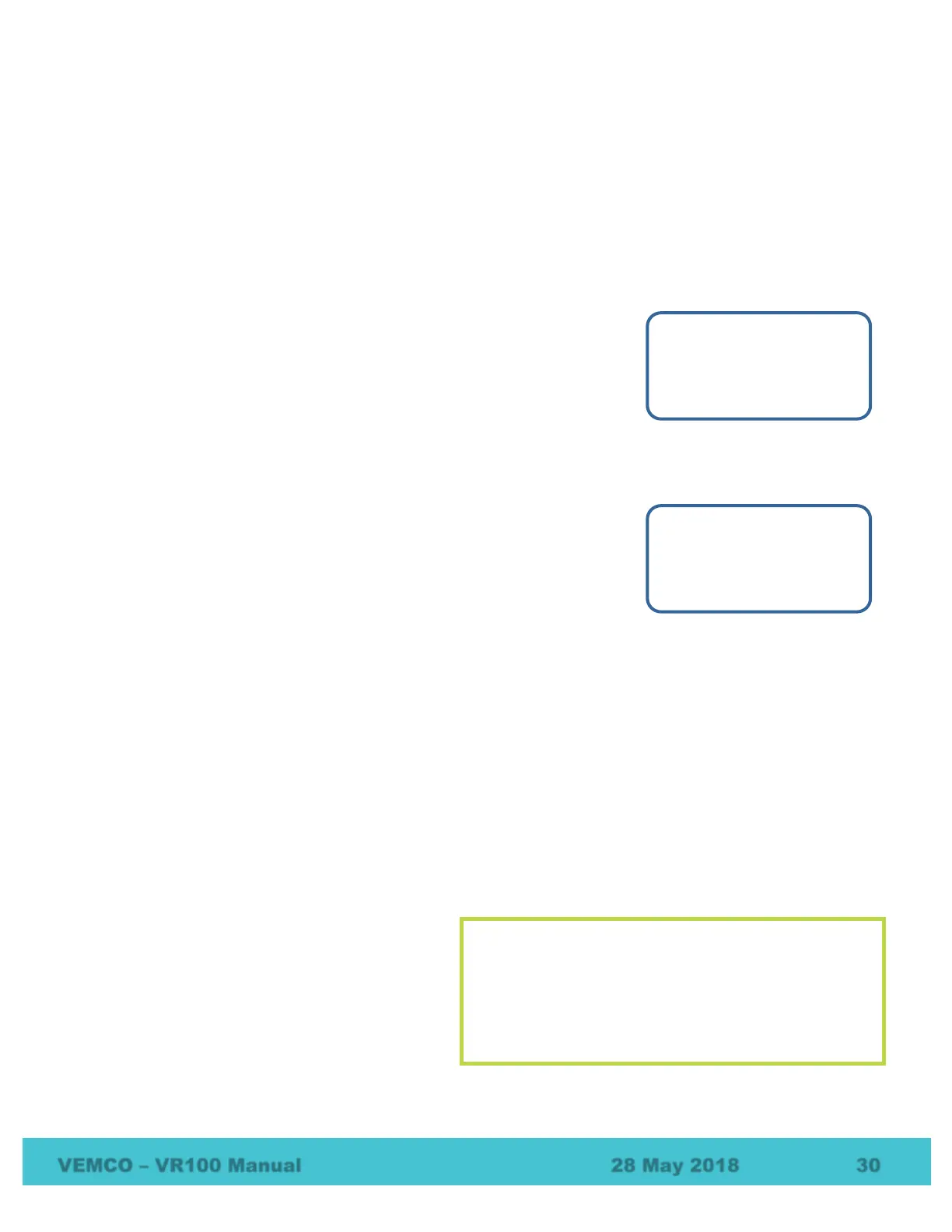
5. Deploy the directional hydrophone (section 4.1.1 contains tips).
6. Use the audio output from either the speaker or the headphones to listen
for the deployed pinger. You may need to rotate the hydrophone to
survey the area.
7. Ensure the receiver is in manual gain mode and adjust the gain so that the pings are strong but not
saturating the receiver. Use the signal strength meter as a guide (signal strength varies from 0 to 105 dB;
try to keep it in the 60 – 80 dB range).
8. Watch the third line for either the tag’s ping period (in milliseconds) if
it’s a continuous tag or the ID number if it’s a coded tag. The “P”
indicates that the received ping was from a continuous pinger. The time,
in seconds, since the last ping was received is shown in the top left
corner. If the length of time is very large, the display will show 999 to
indicate there haven’t been any recent detections.
9. Slowly rotate the hydrophone rod in one direction. If the signal gets louder and stronger (the signal
strength level and bar graph increase) then continue to rotate the hydrophone in that direction. If the
signal gets softer and decreases, then reverse the rotation. When the signal is its strongest, the
hydrophone is pointing in the direction of the tag.
10. Move in the direction the hydrophone is pointing and watch/listen to the signal strength. If the signal
strength decreases, repeat this step until it increases again. If the animal being tracked is operating in
deeper water, then adjust the angle of the directional hydrophone so it’s pointing downward as you get
closer to the tag. If you don’t adjust the angle, you might miss the animal because the hydrophone is
looking at the surface of the water instead of into its depth.
11. If necessary, adjust the gain so that the pings are strong but not saturating the receiver.
NOTE: The gain setting is not critical and in most circumstances satisfactory performance can be
achieved without frequent gain changes.
Continue this process of following the signal
strength and adjusting the gain until the signal
strength is strong in all directions (rotating the
hydrophone doesn’t change the signal strength).
The tag is below the hydrophone.
TIP: If the animal being tracked is operating in deeper
water, then adjust the angle of the directional
hydrophone so it’s pointing downward as you get closer
to the tag. If you don’t adjust the angle, you might miss
the animal because the hydrophone is looking at the
surface of the water instead of into its depth.
LT: 1 09:01:11
69.0 kHz 50dB
▊▊
P 1050 ms
Near CH1 M24 Mute
LT: 26 09:01:31
A69-1303 63dB▊▊▊
#154
Norm CH2 M24 Mute


 To Next Page