VEMCO – VR100 Manual 28 May 2018 2
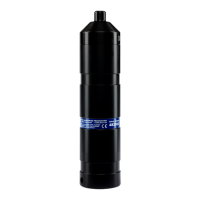
The VR100 receiver is designed to operate with a hydrophone containing a high gain, low noise pre-amplifier
powered by the receiver. An omni-directional hydrophone is useful when identifying activated tags in the
area. A directional hydrophone is used to enable the VR100 receiver to locate and track a transmitter. When
acoustically communicating with VEMCO’s receivers, the transponding hydrophone must be used. More
information about the various hydrophones is found in section 1.6.1.
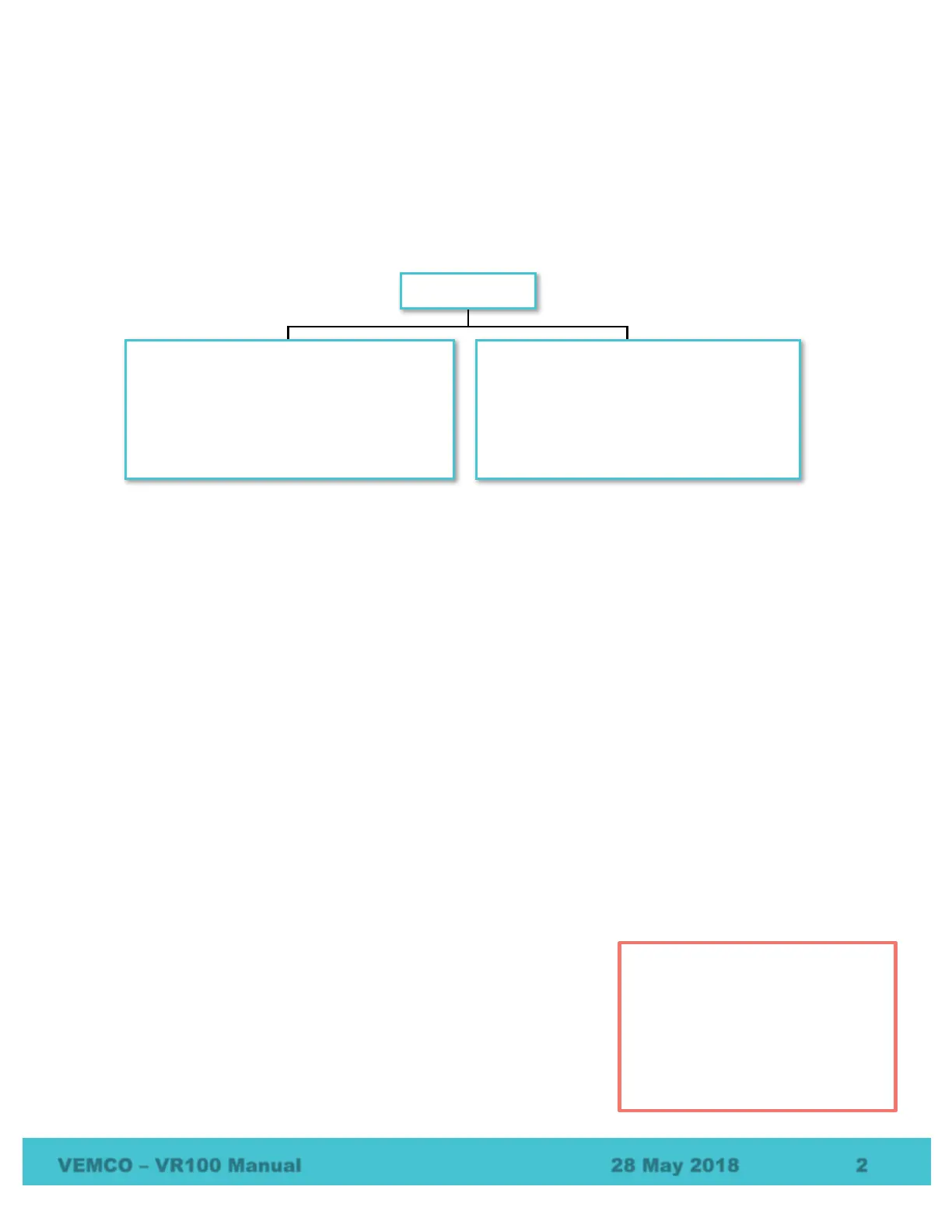
This manual refers to tags, pingers, and sensor transmitters. The relationship these three terms have with
each other is shown in the diagram below. A tag can be a pinger or a sensor transmitter, coded or
continuous.
1.2 Quick Setup
The list below gives the order of actions needed to set up and use the VR100 receiver. The steps may
reference sections in this manual that contain more details about that step.
1. Connect the hydrophone to the bulkhead connector on the side of the case (see section 2.1.1).
2. Power the VR100 receiver by pressing the ON button (see section 1.5.4).
3. Wait for the VR100 to boot up and display the Main screen (see section 6.1.1).
4. Select the appropriate local time offset (see section 2.1.2).
5. Set the display units to be used for sensor transmitters, if applicable (see section 2.1.3 or 3.9).
6. Enter information for sensor transmitters, if applicable (see section 2.2 or 3.8.1).
7. Configure channels for use during monitoring or tracking (see section 2.3).
8. Turn on the channels to be used (see section 2.3.5).
9. Make sure the backlight is in the desired mode (see section 2.1.5.1). Smart Mode is recommended.
10. Adjust the LCD display contrast; if necessary (see section 2.1.5.2).
11. Deploy the hydrophone. Section 1.6.1 contains key points and tips to consider when choosing the
hydrophone to use and section 4.1.1 contains tips for deploying the hydrophone.
12. Monitor the deployed tags as described in section 4.2.2
13. When monitoring is complete, retrieve the hydrophone.
14. Connect the VR100 to the VR100 PC software and offload the data
(see section 3.4).
15. Turn the VR100 off when session is complete.
16. Disconnect the hydrophone from the VR100 case and replace the
connector’s protective cap.
17. Charge the battery for the next deployment (see section 5.2).
These are tags that do not contain a sensor
and don’t transmit data information.
Pinger information is not entered in the
receiver.
These are tags that contain at least one
sensor. They transmit the sensor data.
Sensor transmitter information must be
entered in the receiver.
Fully charge the VR100 battery after
every use and before storage.
Ensure the battery is charged
every three to four months during
storage. If not, the battery can
become fully depleted and
permanently damaged (section 6.3)


 To Next Page