VEMCO – VR100 Manual 28 May 2018 3
1.3 VR100 Case
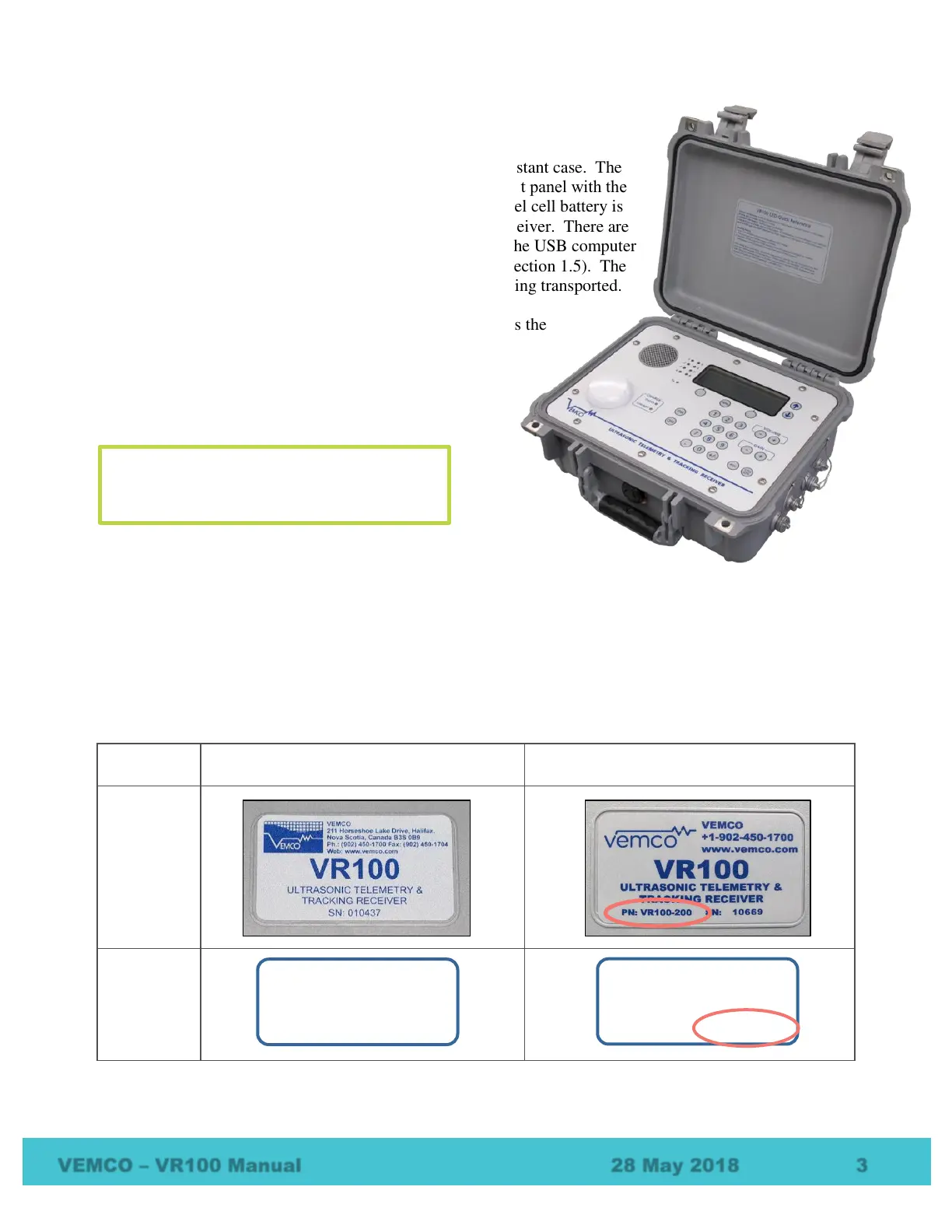
The VR100 receiver is housed in a strong, sealed, splash-resistant case. The
cover of the case must be opened to access the receiver’s front panel with the
LCD display and the soft-touch controls (section 1.5.4). A gel cell battery is
housed inside the case to supply stand-alone power to the receiver. There are
connectors on the right side of the case for the hydrophone, the USB computer
connection, the battery charger, and audio headphones (see section 1.5). The
case should always be latched closed while the receiver is being transported.
The VR100 receiver can be used during a light rain as long as the
hydrophone is connected to the case and the remaining three
protective caps are in place. Water should be wiped from the
front panel with a dry cloth before it accumulates. The USB
cable, battery charger, and headphones should only be used
when the receiver is safe from exposure to water.
1.3.1 VR100 Hardware Versions
There are two major versions of the VR100 hardware covered by this manual, VR100-100 and VR100-200.
You can identify the hardware version of your VR100 by observing the nameplate label, as shown in the
pictures included in the table below.
Both models provide the same basic acoustic receiver functionality, but the VR100-200 has transponding
capabilities (when used with a transponding hydrophone) and has a new GPS and antenna with improved
performance specifications and support for WAAS, EGNOS and MSAS augmentation for enhanced accuracy.
Only use the USB cable, battery charger,
and headphones when the receiver is safe
from exposure to water.
2014 05 28 16:45:11-
GPS: Getting Fix
Sats: 0
Monitor Config
2014 05 28 16:45:11-
GPS: Getting Fix
Sats: 0
Monitor Transpond


 To Next Page