Need help?
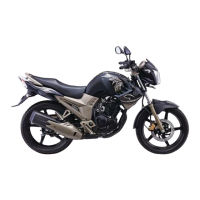
Do you have a question about the Yamaha Scorpio and is the answer not in the manual?
Details for identifying the motorcycle's frame and engine numbers.
Important information regarding disassembly procedures, replacement parts, and components.
List of specialized tools required for tune-up and assembly procedures.
General specifications including dimensions, weight, engine, chassis, and fuel system details.
Maintenance specifications for engine components like cylinder head, camshaft, valves, and piston.
Torque specifications for various fasteners and components, essential for correct assembly.
Chassis specifications covering steering, suspension, wheels, brakes, and drive chain.
Electrical system specifications including voltage, ignition, starting, charging, lighting, and signaling systems.
Diagrams illustrating the routing of various cables and wires throughout the motorcycle.
Maintenance and adjustment procedures for engine components like valve clearance and idle speed.
Maintenance and adjustment for chassis components including front and rear brakes, tires, and steering head.
Inspection and maintenance of electrical systems such as battery, fuses, and lighting components.
Step-by-step procedure for removing the engine from the motorcycle.
Detailed instructions for removing, inspecting, and installing the cylinder head assembly.
Procedures for removing, inspecting, and installing the camshaft and rocker arm components.
Steps for removing, inspecting, and installing the cylinder, piston, and piston rings.
Procedures for separating crankcases, inspecting crankshaft, and assembling crankcase.
Steps for removing, inspecting, and installing the transmission gears and related components.
Instructions on how to safely remove the carburetor from the motorcycle.
Step-by-step guide for disassembling the carburetor into its individual components.
Procedures for inspecting carburetor body, passages, float, jets, and other parts for wear or damage.
Instructions on how to correctly reassemble the carburetor after inspection or cleaning.
Procedure for measuring and adjusting the fuel level in the carburetor float bowl.
Procedures for removing, disassembling, inspecting, and installing the front wheel and brake disc assembly.
Steps for removing, inspecting, and assembling the rear wheel and brake components.
Detailed procedures for servicing the front brake caliper and master cylinder.
Instructions for removing, disassembling, inspecting, and assembling the front fork legs.
Procedures for removing, inspecting, and installing the handlebar and steering head components.
Steps for removing, inspecting, and installing the rear shock absorber and swingarm assembly.
Procedures for checking switch continuity, condition, and connections.
Guide to checking bulb types, conditions, and continuity.
Troubleshooting procedures for ignition system faults like no spark.
Troubleshooting for the electric starting system when the starter motor does not operate.
Troubleshooting steps when the battery is not charging.
Troubleshooting for lighting system issues like headlights or taillights not working.
Troubleshooting for signaling system faults, including horn, lights, and fuel meter.
Common electrical system problems and their potential causes, with visual guides.
Visual guide to common compression system issues like insufficient tightening torque or wear.
Troubleshooting common issues related to the intake and exhaust systems, including air cleaner and fuel tank.
 General
| Compression Ratio | 9.5 : 1 |
|---|---|
| Lubrication System | Wet Sump |
| Frame Type | Diamond |
| Front Suspension | Telescopic Fork |
| Fuel Tank Capacity | 13 Liters |
| Ground Clearance | 165 mm |
| Engine Type | 4-stroke, SOHC, 2 valves |
| Fuel System | Carburetor |
| Ignition System | CDI |
| Transmission | 5-speed |
| Starting System | Electric and kick start |
| Clutch Type | Wet, multi-plate |
| Rear Suspension | Swingarm |
| Front Brake | Disc |
| Rear Brake | Drum |

 To Next Page