IV-35
HEAD-END POSITIONING FUNCTION
(OPTIONAL)
O If the head-end positioning operation is performed with bent work, the
head end of the work may not reach the front vise even when the
work is fed for the preset length.
O When cutting work whose diameter or height is less than 12 mm {0.47
in.} on the machine that is equipped with a head-end positioning
function, enter the cutting data so that the remnant length becomes
150 mm {5.91 in.} or more. If the remnant length becomes less than
150 mm {5.91 in.}, the vise jaws may be damaged.
O Before performing the head-end positioning operation, be sure to
remove the chips from the contact surface at the back of the front vise.
If the chips are deposited on the contact surface, they may be lodged
between the contact surface and work head and may degrade the
accuracy of cutoff pieces.
O If the optional vise pressure control valves are used together, the
head-end positioning operation cannot be performed in principle
because the vise clamping force is reduced. When the vise
pressure control valves are provided, the pressure of the head-end
positioning pressure reducing valve is reduced from a standard level
of 1.5 MPa {15 kgf/cm
2
, 213 psi} to 0.75 MPa {7.5 kgf/cm
2
, 106 psi} at
the time of factory shipment. However, the head-end positioning
function can be used together with the vise pressure control valves
under the following conditions:
• Set the pressure of
the vise pressure
control valves at or
above 2.0 MPa {20
kgf/cm
2
, 285 psi}.
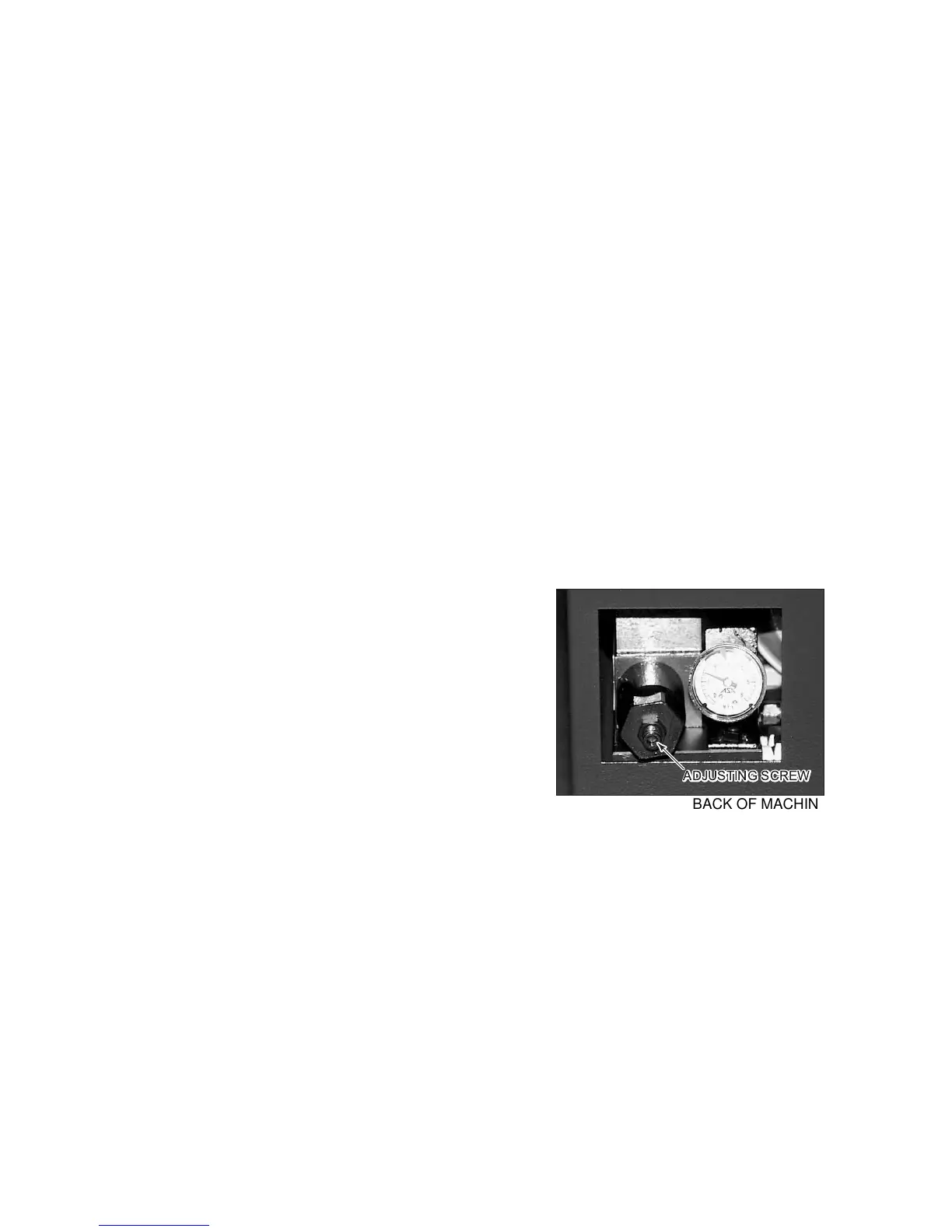
• Adjust the pressure of
the head-end
positioning pressure
reducing valve to 1.5
MPa {15 kgf/cm
2
, 213
psi} with the adjusting
screw.
BACK OF MACHINE
The pressure can be set at a minimum of 0.75 MPa {7.5 kgf/cm
2
,
106 psi}. When feeding heavy work, set the pressure at 1.5 MPa
{15 kgf/cm
2
, 213 psi}.
O When the optional grooveless vise plate is used together, raise the
pressure of the optional vise pressure control valves. Since the
grooveless vise plate reduces the frictional resistance between the
vise and work, the work may slip to increase the likelihood of alarms if
the head-end positioning operation is performed with the pressure of
the vise pressure control valves lowered.
O If the head-end positioning function is used together with the optional
vise pressure control valves, the head-end positioning operation may
not be properly performed.



 To Next Page