FASFAS
MFASMFAS
SMSM
The overhead consists of the following parameters:
FAS, which is the signal for the frame alignment.
MFAS, which is the signal for the multiframe alignment.
SM, which shows the Signal Monitoring.
GCC0-GCC2, which shows the General Communication Channel.
RES, which is the reserved for future international standardization.
TCM1-TCM6, which shows the Tandem Connection Monitoring.
FTFL, which shows the Fault Type and Fault Location.
PM, which shows the Path Monitoring.
EXP, which shows the bytes for experimental use.
APS/PCC, which shows the Automatic Protection Switching and Protection
Communication Control channel.
PSI, which shows the Payload Structure Identifier.
Default defined as: F6 F6 F6 28 28 28. To change a byte value, touch the
relevant byte button to launch the editor dialog box.
If FAS(s) value is changed, a receiver which received the signal with changed FAS might
be able not to detect the frame alignment.
This field counts the OTU frame number. The value changes from 0 through
255 cyclically.
SM consists of the following parameters:
TTI byte (Trail Trace Identifier)
BIP-8 byte (Bit Interleaved Parity level 8 code)
3rd byte:
Bits 1-4: BIP violations (BEI/BIAE)
Bit 5: Signal fail status (BDI)
Bit 6: Frame alignment error (IAE)
Bits 7-8: Reserved for future use
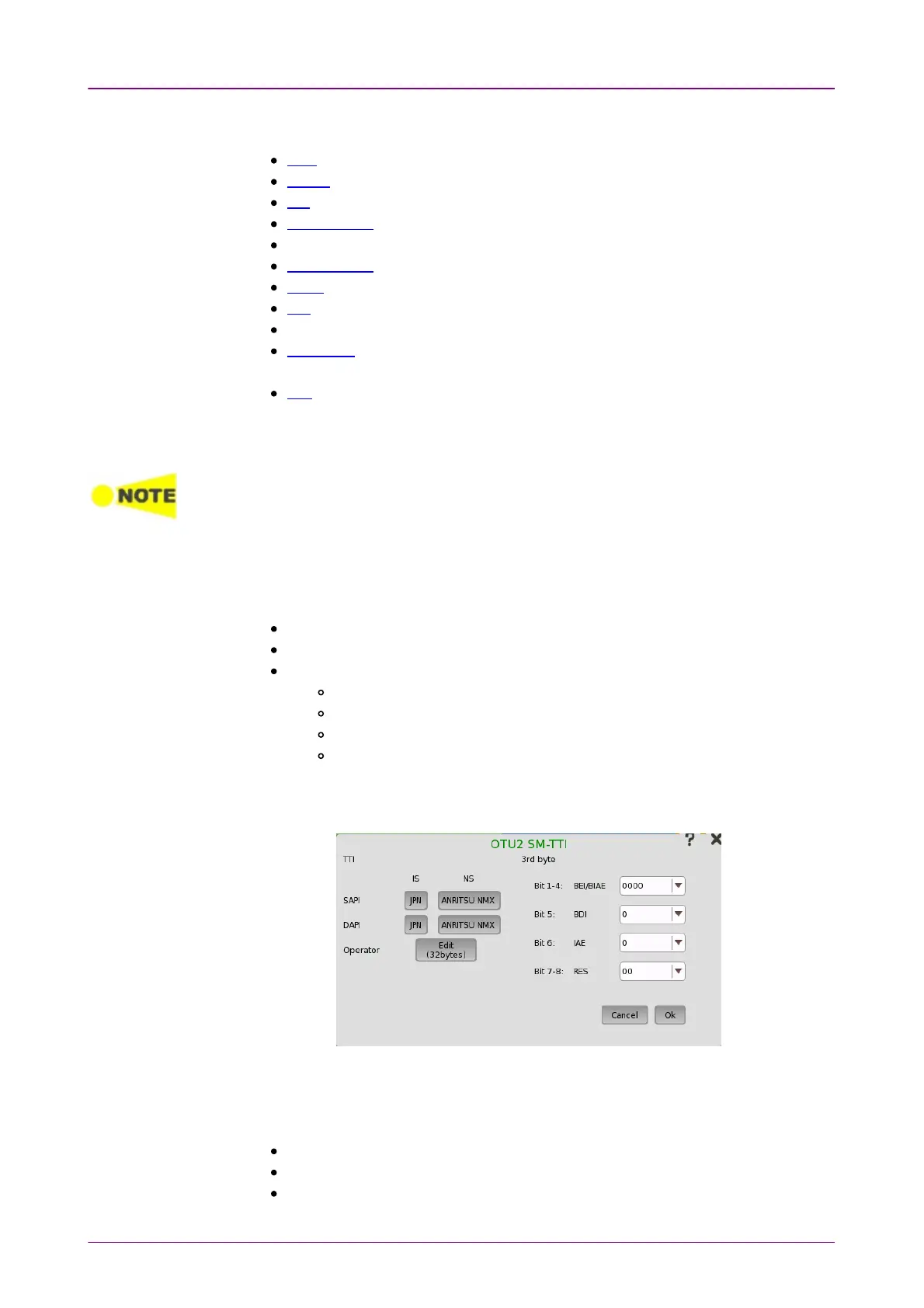
The TTI byte and 3rd byte can both be edited by launching the OTUk SM-TTIOTUk SM-TTI
dialog box.
TTITTI
The TTI (Trail Trace Identifier) is a 64-Byte signal that occupies one byte of the
frame and is aligned with the OTUk multiframe.
SAPI (Source Access Point Identifier)
DAPI (Destination Access Point Identifier)
Operator (32-Byte Operator specific)


 To Next Page