9400200990 Rev I DGC-2020 BESTCOMSPlus Software 4-37
power protection settings automatically switch from the three-phase settings to the single-phase reverse
power protection settings. The 32 element monitors three-phase real power when three-phase sensing is
active or single-phase real power if single-phase sensing is active.
When the total wattage in the tripping direction (generator absorbing power) is greater than the pickup
setting
A
for the duration of the 32 activation delay setting
B
, a reverse power condition is annunciated. A
reverse power annunciation can be user-selected to trigger a pre-alarm
C
(warning) or alarm
C
(shutdown).
A reverse power annunciation can also be user-configured to close a programmable output.
The hysteresis setting
D
functions as a reverse power dropout by preventing rapid switching of the pickup
output.
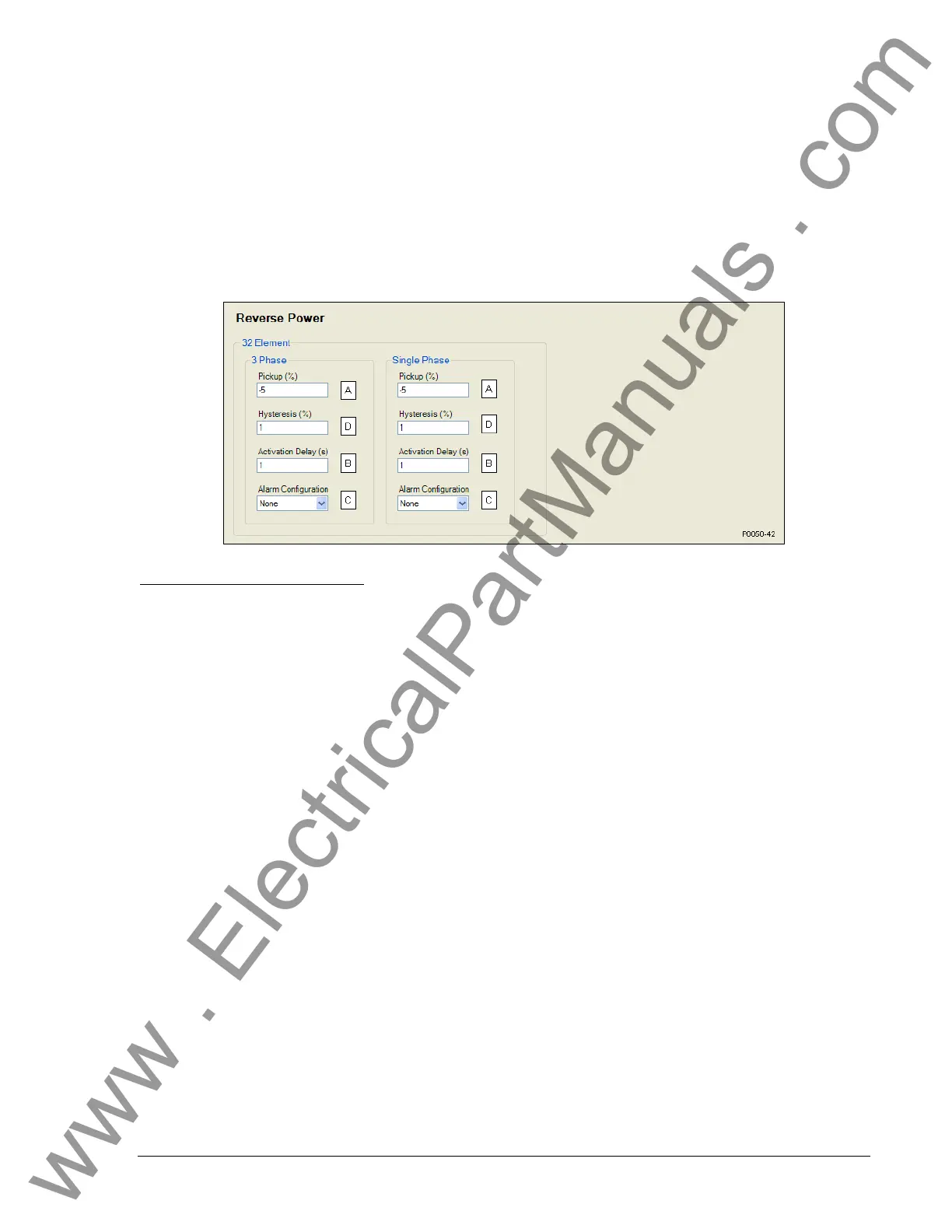
BESTCOMSPlus reverse power protection settings (DGC-2020, Generator Protection, Reverse Power)
are illustrated in
Figure 4-34.
Figure 4-34. Reverse Power Protection Settings
A
Pickup: -50% to 5% of rated watts in 0.1% increments.
B
Activation Delay: Adjustable from 0 to 30 s in 0.1 s increments.
C
Alarm Configuration: None, Alarm, or Prealarm.
D
Hysteresis: Adjustable from 1% to 10% in 0.1% increments.
Loss of Excitation Protection (40Q)
Two sets of loss of excitation settings are provided: one for three-phase generator connections and one
for single-phase generator connections. The pickup setting
A
entered is based on the CT secondary side
(DGC-2020). When a single-phase override contact input is received by the DGC-2020, the loss of
excitation protection settings automatically switch from the three-phase settings to the single-phase loss
of excitation protection settings.
When a generator’s excitation power is lost, the generator acts as a large inductor. The generator begins
to absorb large quantities of vars. The 40Q acts on the principal that if a generator begins to absorb vars
outside of its steady state capability curve, it has likely lost its normal excitation supply. The 40Q monitors
three-phase reactive power when three-phase sensing is active or single-phase reactive power if single-
phase sensing is active. It compares the reactive power to the 40Q response curve defined by the 40Q
pickup setting. Refer to
Figure 4-35.
www . ElectricalPartManuals . com


 To Next Page