
 Need help?
Do you have a question about the Capstone Microturbine C1000 Series and is the answer not in the manual?
Presents safety information for Capstone Microturbine users, emphasizing reading and understanding the manual.
Lists Capstone documents referenced in the installation guide, categorized by type.
States Capstone's right to change publication/products and disclaims liability for installation outcomes.
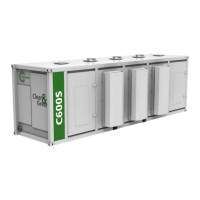
Describes the Capstone C1000S, C800S, and C600S models based on microturbine bay configurations.
Provides instructions for inspecting microturbines upon receipt for shipping damage and proper handling.
Outlines precautions for storing microturbines to minimize corrosion and deterioration during periods of inactivity.
Explains safe rigging practices and lifting methods for the microturbine system.
Lists components that must be installed on the enclosure before operation, referencing installation guides.
Discusses how various climatic conditions affect microturbine installation and operation.
Outlines the importance of complying with local, national, and international standards and codes.
Provides guidelines and requirements for connecting a microturbine installation to a utility grid.
Provides specifications for gaseous and liquid fuel connections, referencing relevant tables and drawings.
Details exhaust connection requirements, including diameter, temperature rating, and backpressure limits.
Covers electrical connection considerations, including conduit installation and high power connections.
Covers foundation design, mounting considerations, and component weights for system installation.
Discusses the importance of microturbine orientation for site design and system performance.
Details required clearances for maintenance, service, and repair of the microturbine system.
Explains the criticality of proper ventilation for microturbine performance and longevity.
Describes components for pipeline natural gas fuel conditioning and responsibilities for its system.
Defines raw natural gas and highlights special pretreatment considerations due to contaminants.
Defines biogas and emphasizes special pretreatment needs due to common contaminants.
Characterizes LPG and notes special considerations for its vaporization and fuel system components.
Addresses general factors for gaseous fuels, including pressure, dew point suppression, and condensate removal.
Outlines general requirements for electrical connections, grounding, and load analysis for Capstone products.
Details protective earth (PE) grounding requirements for microturbine chassis and neutral grounding.
Covers requirements for overcurrent protection devices such as circuit breakers or fused disconnects.
Discusses transformer applications, sizing, and input impedance calculations for grid connect installations.
Describes Grid Connect mode operation, including utility synchronization and protective relays.
Defines Stand Alone mode where the turbine solely supports the load and maintains voltage.
Explains Dual Mode connections and how the DMSC controls transfer between Grid Connect and Stand Alone modes.
Recommends power quality studies to identify and avoid challenges associated with harmonics.
Details Ethernet communication setup for microturbines and controllers using CRMS.
Describes external connections made to terminal block TB1 of the C1000 series controller.
Describes external connections made to terminal block TB3 of the C1000 series controller.
Explains connecting external controllers like CLC to microturbines for enhanced control.
 General
| Model | C1000 Series |
|---|---|
| Power Output | 1000 kW |
| Control System | Advanced digital control system |
| Fuel Type | Natural Gas, Diesel |
| Voltage Output | 480 VAC |
| Frequency | 60 Hz |
| Dimensions | Approximately 6.1 m L x 2.4 m W |
| Emissions | Ultra-Low Emissions (NOx < 9 ppm, CO < 25 ppm, UHC < 25 ppm corrected to 15% O2 dry) |
| Efficiency | 33% (electrical) |

 To Next Page