Patient Monitor User Manual Monitoring IBP
- 98 -
WARNING
1 Prolonged inflation can cause pulmonary hemorrhage, infarction or both. Inflate the
balloon for the minimum time necessary to get an accurate measurement.
2 If the PAWP (mean) is greater than the PA (systolic), deflate the balloon and report
the incident in accordance with hospital policy, because the pulmonary artery could
be accidently ruptured, and the PAWP value derived will not reflect the patient’s
hemodynamic state, but will merely reflect the pressure in the catheter or balloon.
3 The pressure receiver in the catheter records the pressure change that occurs only at
the front of the obstruction.
4 Due to the short measurement delay, do not use sidestream CO
2
as a direct
reference to determine the end point of the breath in the pressure curve.
5 If the balloon is not inflated but the pulmonary artery floating catheter enters the
wedge position, the pulmonary artery pressure waveform becomes wedge-shaped.
Follow the standard steps to take appropriate action to correct this situation.
6 PAWP measurement is not applicable to pediatric and neonate patients.
14.7 Calculating CPP
CPP is calculated by subtracting MAP and ICP, it means: CPP=MAP-ICP.
14.7.1 Calculation Procedures
To start CPP calculation:
1. Click the ICP parameter area to enter into ICP Options interface, select Setup to enter into
ICP Setup > CPP Source; CPP source is defaulted as the currently opened artery, it can be
selected as Art, P1 or P2. If there is more than one arterial pressure at the same time, the
priority level should be: Art > P1 > P2.
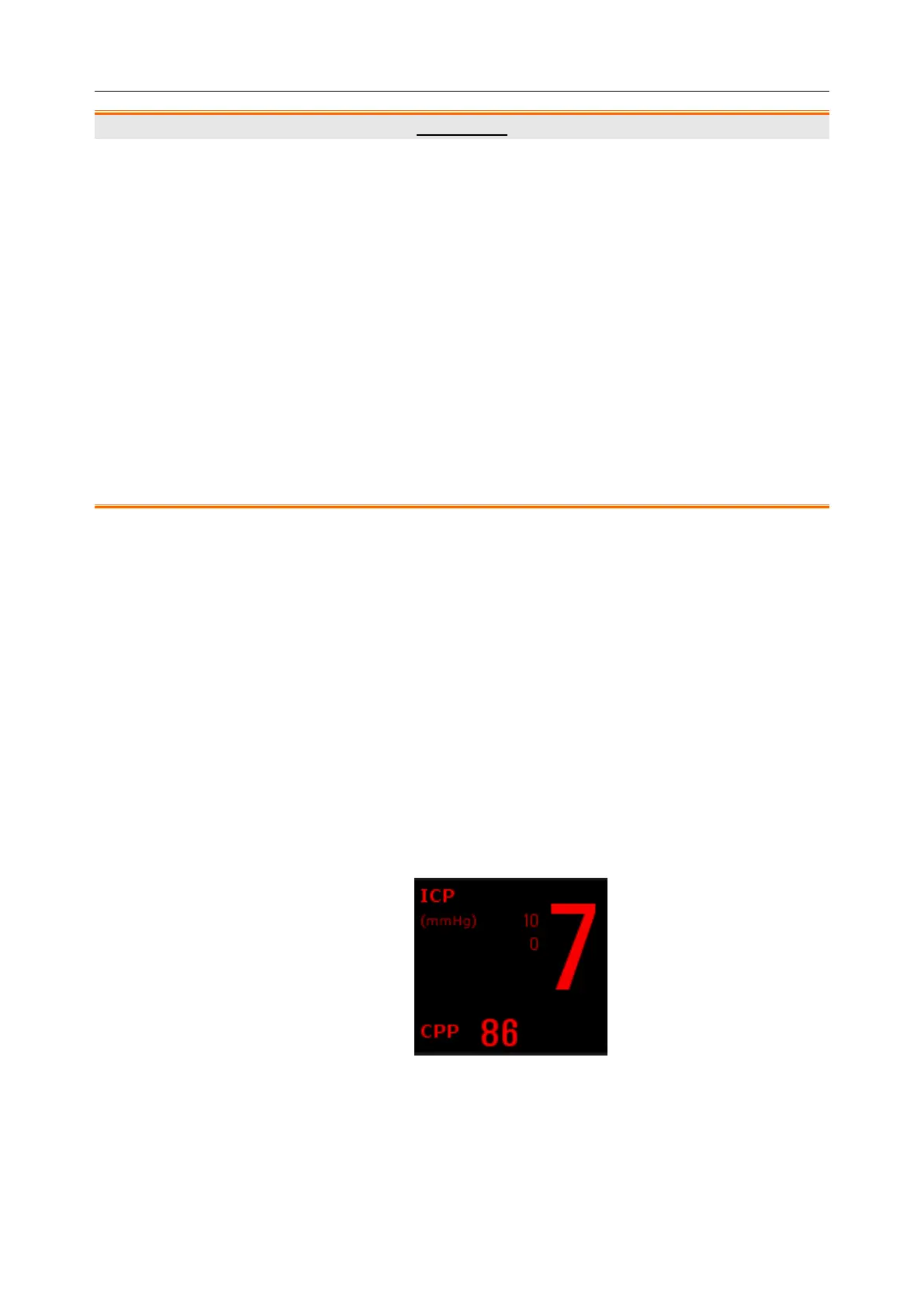
2. Take P1 as example: if P1 is selected as CPP Source, when MAP and ICP are both measured,
ICP area will display CPP and its value as below picture, unit is same as ICP. Invalid CPP
will display “-?-”. CPP will be closed if exit ICP parameter.
14.8 Calculating PPV
Pulse Pressure Variation (PPV) is calculated from the specific arterial pressure values, which
reflects the variation between the maximal pulse pressure and the minimum pulse pressure in 30
seconds. Pulse pressure is affected by left ventricular-stroke volume, arterial resistance and
arterial compliance.


 To Next Page