DCM00002 REV. 16 23
2.5.9 Resonant Frequency
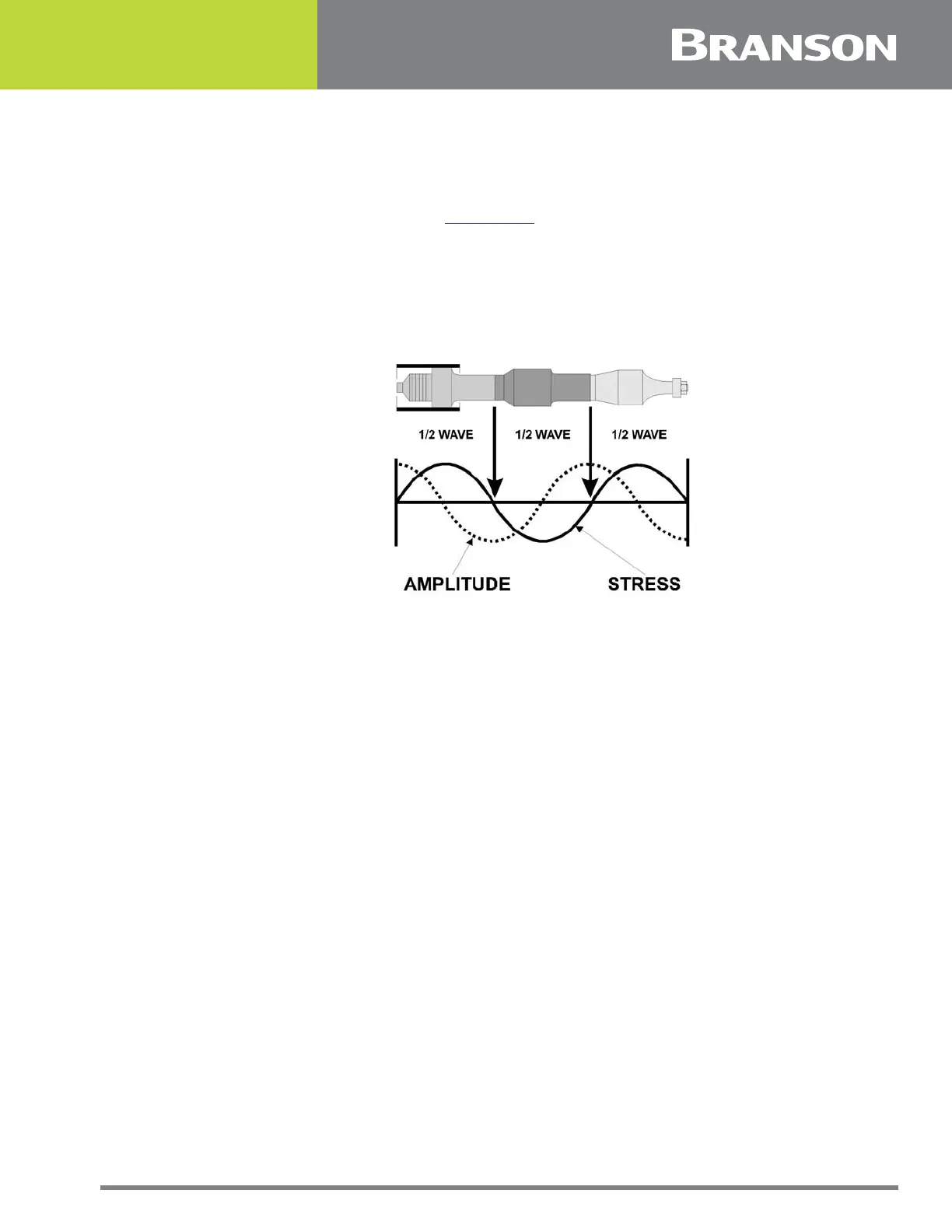
The ultrasonic tooling acts as a spring having node points and anti-node points. The
mechanical energy used to vibrate the tool is created by the converter. As the vibrations
are propagated through the acoustical tool, a harmonic resonance is established
consisting of nodes and antinodes. This action results in a resonant wave being
transferred through the tooling (
Figure 2.10). The efficiency of the resonant wave transfer
depends on the natural resonant frequency of the horn and is determined by two factors:
The speed of sound through the material.
The geometric shape of the object.
Figure 2.10 Harmonic Resonance on Ultrasonic Tooling.
2.5.10 Avoiding An Overload Condition
It is possible to increase the Amplitude and or the Pressure to a point where the power
available is not adequate to initiate or maintain vibration under the given mechanical load.
At this point, the power supply will stall resulting in an Overload condition. Electronic
circuits in the system will protect the power supply if this condition exists.
2.5.11 Welding To Time
In specific applications, ‘Welding To Time’ may be desired. As previously mentioned, there
are three primary variables that interact; they are:
• Time: The duration of applied ultrasonic vibration
• Amplitude: The longitudinal displacement of the vibration
• Force: The compressive force applied perpendicular (normal) to the direction of vibration
Generally, welding for a specific time will produce acceptable results when:
• The equipment is installed on an automated production line and each station must complete its
process within a certain time limit
• Very small low energy welds on clean components are being made
2.5.12 Welding Temperature
Ultrasonic welding produces a localized temperature rise from the combined effects of
elastic hysteresis, interfacial slip and plastic deformation. The weld interfaces reach
approximately 1/3 the temperatures needed to melt the metals. Since the temperature
does not reach the melting point of the material, the physical properties of the welded
material are preserved. As the ultrasonic welding process is an exothermic reaction, as
welding time increases so does weld temperature.



 To Next Page