24 DCM00044 REV. 14
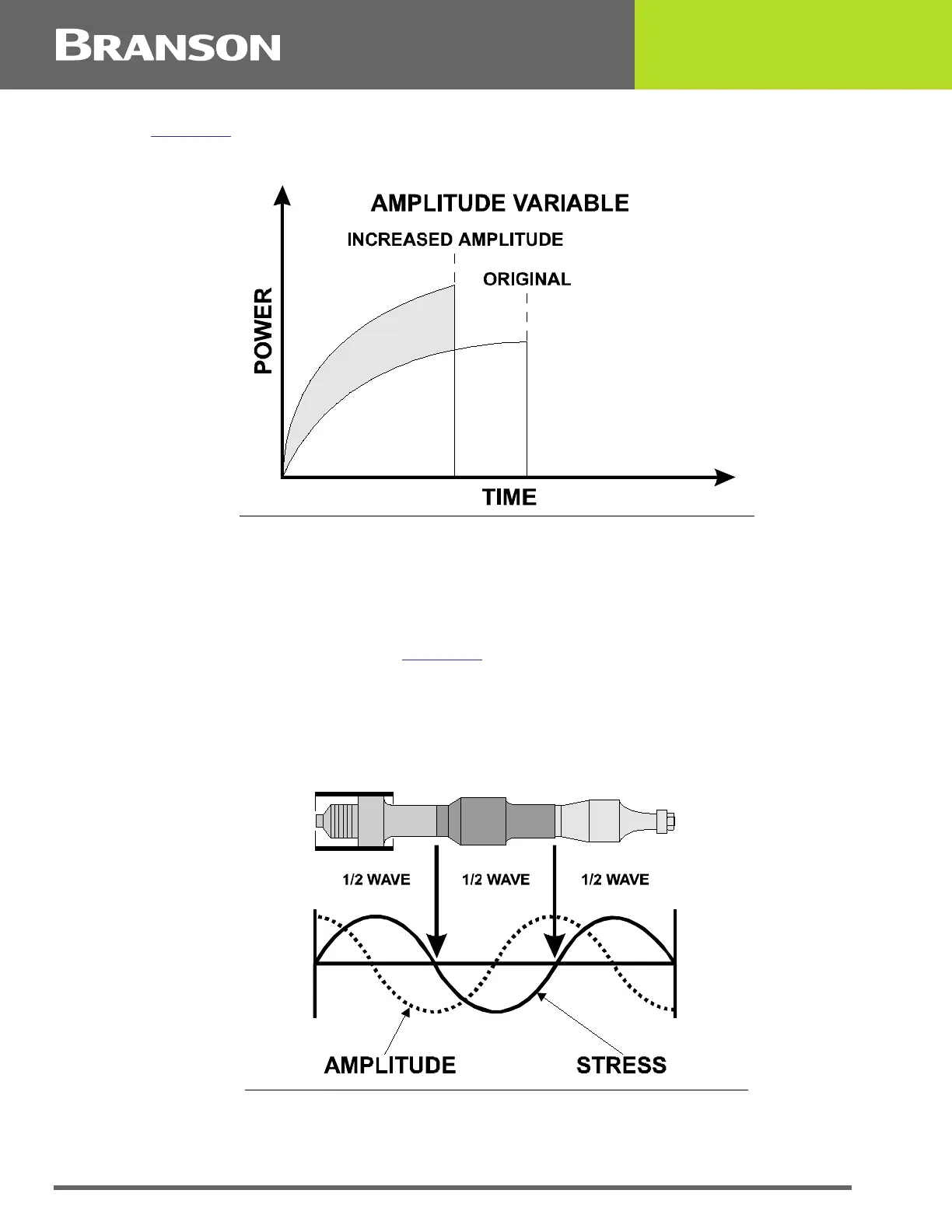
the same amount of Energy. This relationship is illustrated in the following power diagram
(Figure 2.8):
Figure 2.8 Amplitude’s Influence on Weld Power and Time
2.5.8 Resonant Frequency
The ultrasonic tooling acts as a spring having node points and anti-node points. The
mechanical energy used to vibrate the tool is created by the converter. As the vibrations
are propagated through the acoustical tool, a harmonic resonance is established
consisting of nodes and antinodes. This action results in a resonant wave being
transferred through the tooling (Figure 2.9
). The efficiency of the resonant wave transfer
depends on the natural resonant frequency of the horn and is determined by two factors:
• The speed of sound through the material
• The geometric shape of the object
Figure 2.9 Harmonic Resonance on Ultrasonic Tooling.



 To Next Page