Page 55 of 159
7 Sample Measurement
7.1 Sample Types Supported by the ‘ELite 5’
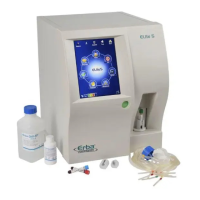
In this chapter you will find information about the samples usable with the ‘ELite 5’ analyzer.
7.1.1 Supported Sample Tube Types
The ‘ELite 5’ supports the following K
3
-EDTA, 13x75 mm sample-tubes:
• Sarstedt Monovette
®
• Becton Dickinson (BD) Vacutainer
®
• Terumo Venosafe
®
• BD MAP
®
tube (only in SSM mode)
Please note that the Sarstedt Monovette
®
sample tubes have a false bottom that is
not the same as the bottom of the sample tube. The sampling depth on the ‘ELite 5’
analyzer must be changed for a Sarstedt Monovette
®
sample tube. To change the
sampling depth for manually presented Sarstedt Monovette
®
tubes at the sample
rotor, check the ‘Use only Sarstedt Monovette tube from sample rotor’ check box in
the Main menu/Settings/System panel.
The Autosampler automatically recognizes Sarstedt Monovette
®
tubes and
automatically changes the sampling depth.
You may use sample tubes from other vendors if certain conditions are fulfilled. For manually
presented sample tubes at the sample rotor measurement check if the new tube type:
• Is mechanically compatible (13x75 mm family)
• Can be pierced or used in open vial mode
• Can be handled by the tube centralizing mechanisms on the ‘ELite 5’ analyzer
It is suggested to contact your sales representative before using the new sample tube type.
For automated sample handling with the optional Autosampler, contact your sales
representative before using a new sample tube type. The Autosampler may not reliably
recognize sample tube types other than the officially supported sample tubes.
Although these sample tube types are designed for multiple piercing, it is
recommended to replace the cap after 3-4 piercing cycles. Small rubber bits parts can
crumble into the blood and adversely affect the performance of the ‘ELite 5’ analyzer.
7.1.2 Sampling Depth
The ‘ELite 5’ is equipped with a piercing needle capable of aspirating samples from closed
sample tubes. To prevent needle blockage from rubber sample tube cap material and blood
particulates, the piercing needle hole is located on the side of the needle rather than at the
bottom. Also, the sampling needle is given a safety clearance of two millimeters from the
bottom of the tube to prevent accidental breakage of sample tubes. This means that the
sampling needle cannot aspirate the last 8 millimeters (0.31 inches) of sample at the bottom
of a tube. This results in sample volume that cannot be aspirated of 0.5 ml for a Beckton
Dickinson Vacutainer
®
tube and 0.3 ml for a Sarstedt Monovette
®
tube.


 To Next Page