Operation
Manual 20791, Rev. C, June 2001 2-93
2.11.6 Cursors on Multiple Channels
Whenever cursors are used on multiple channels, they will always be tied to the same frequency but will
show the appropriate amplitude on each channel. This is particularly useful when the cursor finds a
feature of interest on one channel. Then, the corresponding amplitude can be read from another
channel.
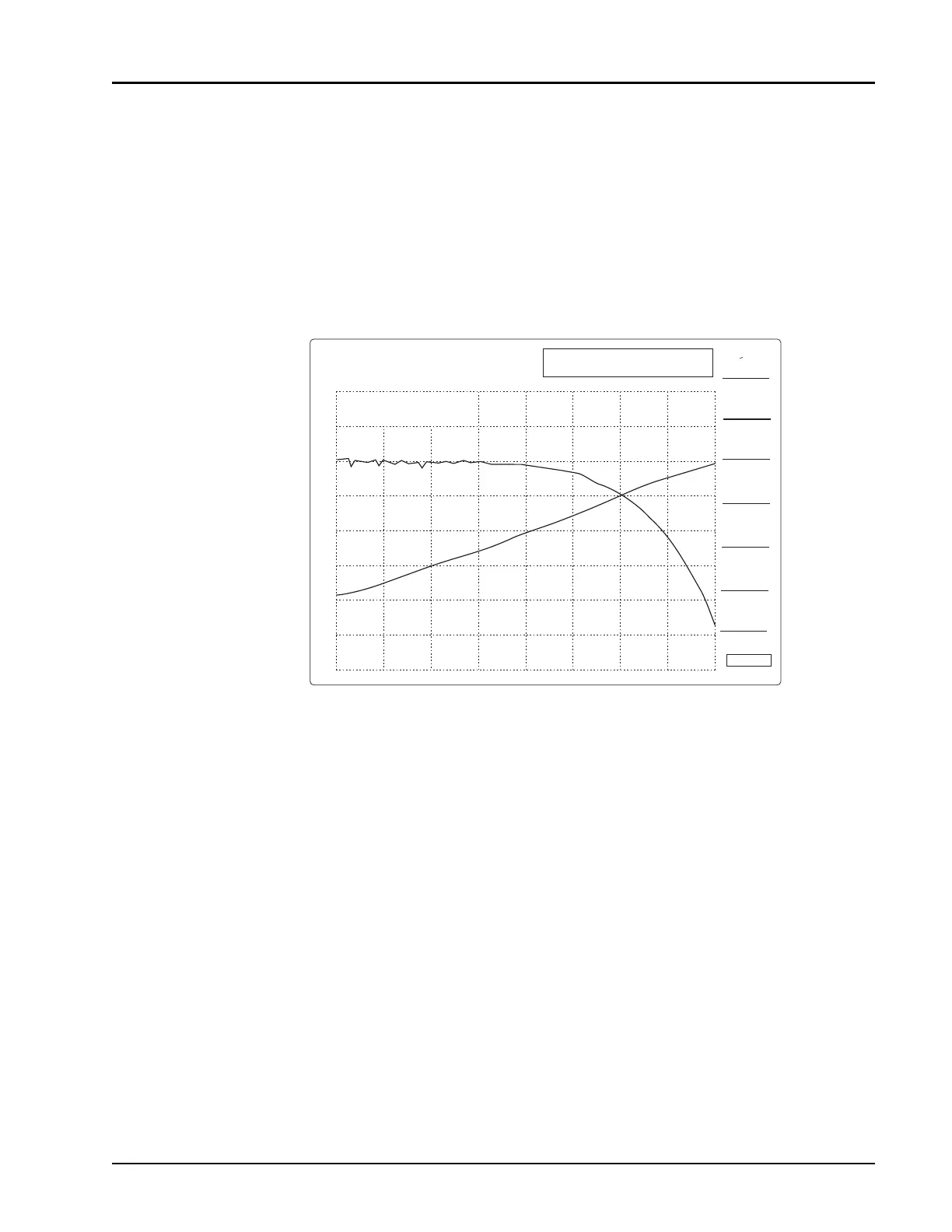
An example of this is a 1 dB compression measurement on an amplifier (see Figure 2-49). Suppose
channel 1 is set to measure gain vs. input power, and channel 2 is set to monitor the output power of the
amplifier. The cursor SEARCH functions find the point where gain decreases by exactly 1 dB on
channel 1. The corresponding output level on channel 2 is the 1 dB compression level of the amplifier.
Figure 2-49: Cursors (Each Channel) Tied to Same Frequency Help Finding the 1 dB
Compression Point on an Amplifier
CURSOR
ON/OFF
∆
SEARCH
CURSOR
ON/OFF
CURSOR
FREQ
CRSR 16.06 dBm
10.001 GHz
CH1 : SW B/A-PC CRSR 9.30 dB
0.5 dB/ REF 10.31 dB
CH2 : SW B CRSR 16.06 dBm
5.0 dB/ REF 8.91 dBm
2
1
CURSOR ->
MRKR N
DEFINE
MRKR N
REF ->
CURSOR
CURSOR
CH1 - AMPLIFIER GAIN
CH2 - AMPLIFIER OUTPUT POWER



 To Next Page