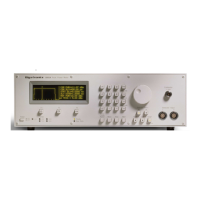
8003 Precision Scalar Analyzer
3-36 Manual 20791, Rev. C, June 2001
3.3.21 CW Power Measurement Command Structure
POWER
Syntax: POWER [?] hs channel specifier [ds sensor specifier] [us trigger mode] [us modifiers]
Specifiers: Channel specifier: 1 through 4
Sensor specifier: A, B, C, (A/B, A/C, B/A, B/C, C/A, C/B, A-B, A-C, B-A,
B-C, C-A, or C-B allowed for trigger mode TØ only)
Trigger Modes:
Trigger mode syntax: TØ, T1, T2, T3
Default trigger mode: TØ
General Description:
Once the trigger mode is set, the 8003 will remain in that trigger mode until another trigger
mode command is sent. If the POWER command is sent with one of the fast data modes
(T1 through T3), the analyzer will freeze its display to maximize data rate through the
GPIB bus. When any one channel is put in one of the fast data modes, all channels
change to the same fast data mode. To place the instrument in the standard TØ mode with
display updates, do any of the following:
• Send the POWER command with mode TØ
• Send a DEVICE CLEAR bus command to the analyzer
• Send an INTERFACE CLEAR bus command
• Put the instrument in LOCAL mode - either manually or over the bus
In the fast data modes (T1 through T3), it is advisable to use the RDTEMP command to
periodically update low level temperature and offset drift correction. See the description
for the RDTEMP command in Section 3.3.22.
Normal CW Mode:
Trigger mode name: TØ
This is the analyzer’s default power-up mode. In this mode, the analyzer free-runs at a
relatively slow data rate. The mode offers familiar power meter functionality to the user
with channel ratioing and differences, averaging, max and min holds, and relative
measurements - although at a slower reading rate than the fast CW modes described
below. When the analyzer receives an OUTPUT [channel#] command over the bus, it will
send the current power reading for that channel to the controller (see the OUTPUT
command description in Section 3.3.19 for more information). The power reading is
corrected for Cal Factor, temperature, and low-level offsets. Reading rate is fairly slow
(greater than 10 readings per second). The analyzer will wait until it is talk addressed, and
then it will return the reading in the format
±
ddd.dd in dB.
Fast Free-run CW Mode:
Trigger mode name: T1
In this mode, the analyzer makes high speed CW power measurements. The analyzer
free runs but does not update the display to maximize measurement speed. The free-run
mode is the simplest to use, and is intended for ATE measurements where the timing of
the reading is not extremely critical. All four channels may be used and configured in any
sequence of sensors but channels are restricted to single-sensor-per-channel measure-


 To Next Page