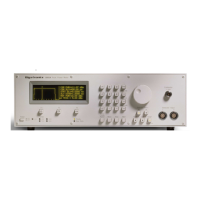
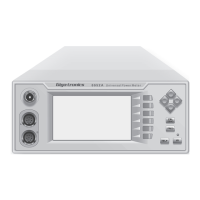
8003 Precision Scalar Analyzer
4-12 Manual 20791, Rev. C, June 2001
4.3.7 AC Mode Output Connector Check
The 8003 AC Modulation Output voltage default values are +5V (AC Modulation off), and a square
wave switching between +5V and 0V (AC Modulation on), at a nominal 1kHz frequency. The 8003
can generate different voltages using values stored in an internal lookup table depending on the sweeper
to which it is connected via the GPIB/Private port.
1. Connect the AC Mod Output to the Vertical input on the oscilloscope. Set the oscilloscope as
follows:
Coupling: DC
Volts/Div: 2V /Div
Time/Div: 200
µ
µµ
µ
s/Div
Triggering: AC/Auto/Int
2. Ground the oscilloscope input and center the trace.
3. Set the 8003 to the DC Mode of operation.
[CONFIG] [SENSORS AC/DC]
[ALL DC]
4. Select DC coupling on the oscilloscope, and check that it indicates a positive voltage of 5V.
5. Set the 8003 to the AC Mode of operation.
[CONFIG] [SENSORS AC/DC]
[ALL DC]
6. Check that the oscilloscope displays a square wave, repetition frequency between 500 Hz and
1.5 kHz, voltage between 0V and+5V.
4.3.8 Bias Output Connector Check
The following steps are used to confirm that the Bias Output Voltage connector is functional. These
steps can be bypassed if it not intended to use this capability for applications such as supplying power to
PIN diode attenuators.
In the following procedure it is recommended that the 8003 be set to display channel only, and that a
sweep time of 1 second be set on the sweeper.
[CH 1] [CH 2] [OFF] [CH 3]
[OFF] [CH 4] [OFF] [SWEEP TIME] [1] [S]
1. Set the 8003 to be in the Graph/Swept Mode.
[DISPLAY] [GRAPH] [DEFINE] [SWEPT]
NOTE:
The Bias Voltage Output is channel dependent, and only on during the sweep time
for each channel which has been configured by the user to output a bias voltage.
☛
☛☛
☛


 To Next Page