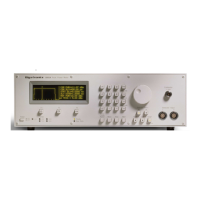
8003 Precision Scalar Analyzer
1-8 Manual 20791, Rev. C, June 2001
Channel Offset: -90 to +90 dB in .01 dB increments.
Autoscale: Automatically sets the scale factor, reference level, and reference
position to provide an optimum display of the active channel.
Averaging: 2, 4, 8, 16, 32, 64, 128, or 256 successive traces (swept) or readings
(CW) can be averaged to reduce the effects of noise on
measurements.
Smoothing: Provides a linear moving average of adjacent data points. The
smoothing aperture defines the trace width (number of data points) to
be averaged. The smoothing aperture can be set from 0.1% to 20%
of the trace width.
Adaptive Path Calibration
(Normalization): Traces are stored in non-volatile memory and normalized with the
highest resolution, independent of display scale/division or offset.
4096 points for each trace are stored over the full frequency range of
the sweeper or any user-selected frequency range. Normalization
data is automatically interpolated for ranges within the original
normalized range.
Trace Memory: Ten traces can be stored in non-volatile memory and recalled.
Memory traces can be individually labeled. Stored traces can be
displayed, and trace differences from any measurement can also be
displayed.
Settings Store and Recall: Allows up to nine full front panel setups plus a power-down last
instrument state can be stored and recalled from non-volatile
memory.
Limit Lines: Horizontal, sloped, and/or single point lines for each trace can be set
as go/no-go data limits. Limit lines are stored in non-volatile memory.
Complex limit lines can be entered through the front panel or via
GPIB interface.
1.3.1 Cursors & Markers
Cursor: The cursor can be positioned with the tuning or via the numeric
keypad. The frequency and amplitude of test data at the cursor on all
active channels is digitally displayed.
Cursor Delta: Displays the differences in dB and frequency between the reference
cursor and the main cursor.
Cursor Min/Max: Moves the cursor to the minimum or maximum value of test data.
Cursor x dB: Moves the cursor to the point on the trace equal to the value of x in
dB or dBm.
Cursor x Bandwidth: Displays cursors to the right and left of the cursor at the frequencies
where the test data is equal to the value of x dB. The bandwidth
between the cursors is displayed.
Cursor Flatness: Displays the difference in dB between the Max and Min values on the
active channel.
Ref to Cursor: Changes the Ref Level to the level at the cursor.
Markers: Displays up to 10 markers generated by the 8003. The cursor can be
moved directly to any marker or sequentially through the markers.


 To Next Page