Characteristics Directional TDF/DCF Antenna:
Maximum connection length with a shielded twin-lead cable: 100 metres
Maximum distance in relation to the DCF transmitter (Frankfurt – Germany) or TDF transmitter (Allouis
– France) = 2000 kms.
The values indicated above may decrease depending on surrounding landscape and weather situation
of the moment.
2.1.10. Radiosynchronised version using GPS Antenna
Frequency received: 1575 MHz (L1)
Code: GPS code is converted into DCF code
Position the antenna so that it is most exposed to the satellites.
Number of channels: 12 channels
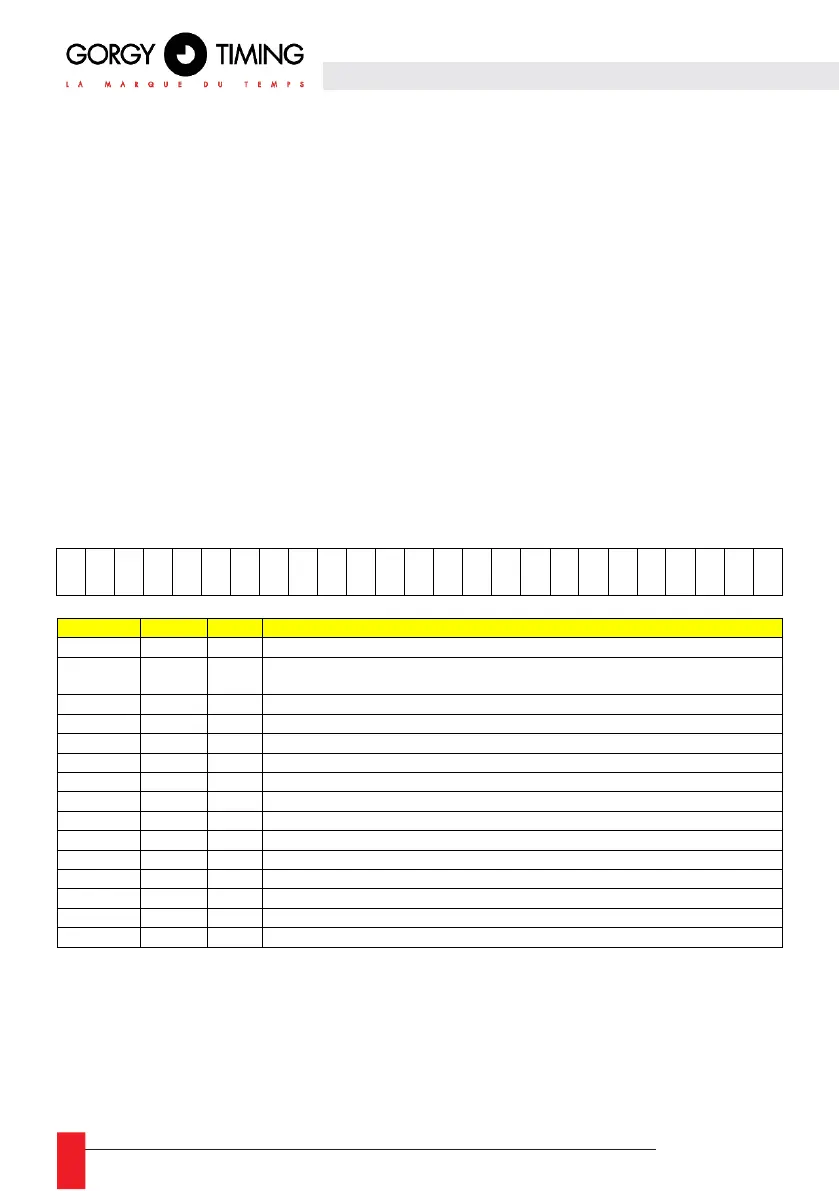
2.1.11. ASCII RS232 or RS485 Version
Extinction of the two second dots: 5 seconds without synchronization. In this mode, the clock emits a
code every second
(Configuration: 2400 bauds, size 8 bits, even parity, 1 stop bit):
Start of Text ($02) – mark the beginning of the frame.
The day in the week in a human-readable way (MON, TUE, WED, THU,
FRI, SAT, SUN for Monday to Sunday)
Day in the month on two ASCII characters ($30,$31 to $33,$31)
Forward slash character ($2F)
Year on two ASCII characters ($30,$30 for 2000 – $39,$39 for 2099)
Forward slash character ($2F)
Year on two ASCII characters ($30,$30 for 2000 – $39,$39 for 2099)
Two Space characters ($20)
Hours on two ASCII characters ($30,$30 to $32,$33)
Minutes on two ASCII characters ($30,$30 to $35,$39)
Seconds on two ASCII characters ($30,$30 to $35,$39)
Carriage Return ($0D) – mark the end of the frame
► This ASCII code can be:
1 - Time information, according to the described protocol in the above table, gene-rated via a RT4000
or any other ASCII code generator.
2 - Information from another clock of the same type working in transmitter mode; in this case, the clock
is completely slaved to the other.
3 - In HORO QUARTZ specific version, the time information is coming from a HORO QUARTZ
attendance system.


 To Next Page