GSE Scale Systems - 9
Chapter 2 Installation Instructions Technical Reference Manual
ESD shielding performance. Test the instrument for
proper operation.
2.3 Local Load Cell Connections
Transducer Excitation
The 574 is designed to be connected to a packaged cell
and harness (local cell mounted in 574 housing). These
loadcell harnesses are of specific capacities with
matching mating connectors for connection to the 574
main board. These cells are specifically selected to be
within the full capacity limitations of the top support
(spider). For sample or remote scale connections (multi-
scale options), refer to chapter 22, Multi-Scale Input.
The unit supplies 10 VDC developed from +5VDC
and -5VDC referenced to common for the excitation
voltage. The maximum excitation supply current
available for the load cell(s) is 230 mA which
corresponds to the ability to drive the equivalent of a
quantity of eight 350 ohm load cells.
Cable Recommendations
A high quality cable having an overall braided shield and
16 to 24 AWG stranded wire is supplied with the load
cell/harness. The load cell cable should be routed
through the structural channel under the 574 housing to
the right of the cell itself. The cell should be completely
free of any extra cabling in order to function properly.
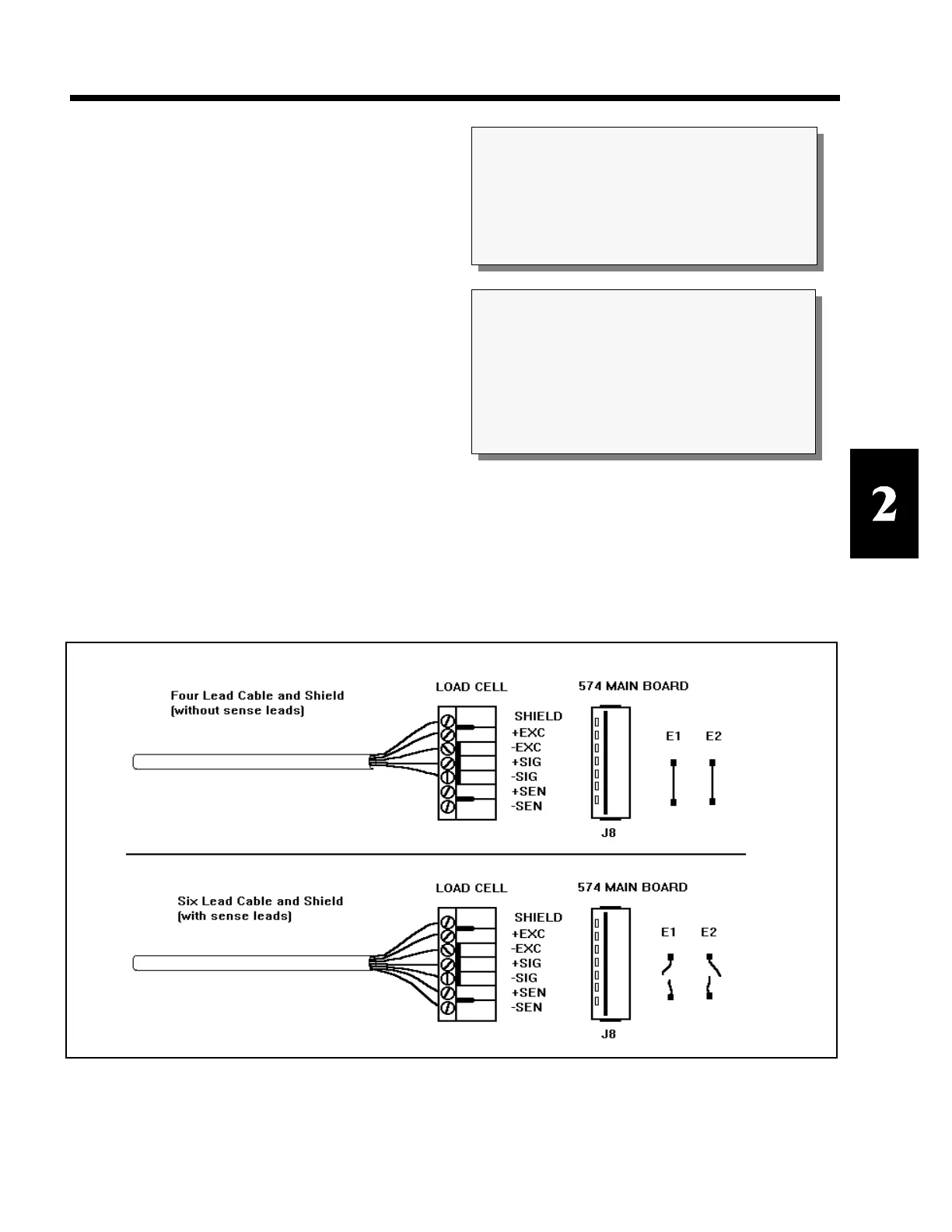
Sense Lead Connections
SECTION - 2.3
NOTE:
For load cell harnesses with 6 conductors, two
small jumper wires (E1 and E2, next to J8 on the
Main PC Board) must be cut for external sensing to
be operational. For a complete explanation, refer to
the Sense Lead Connections section in this chapter.
NOTE:
The PC board mounting nuts are also used to
establish the earth ground reference for the circuitry
on the PC board and thus the nuts must always be in
place when the 574 is powered up!
Figure 5 Load Cell Connections



 To Next Page