Chapter 9
9. Canine Fibrinogen Test
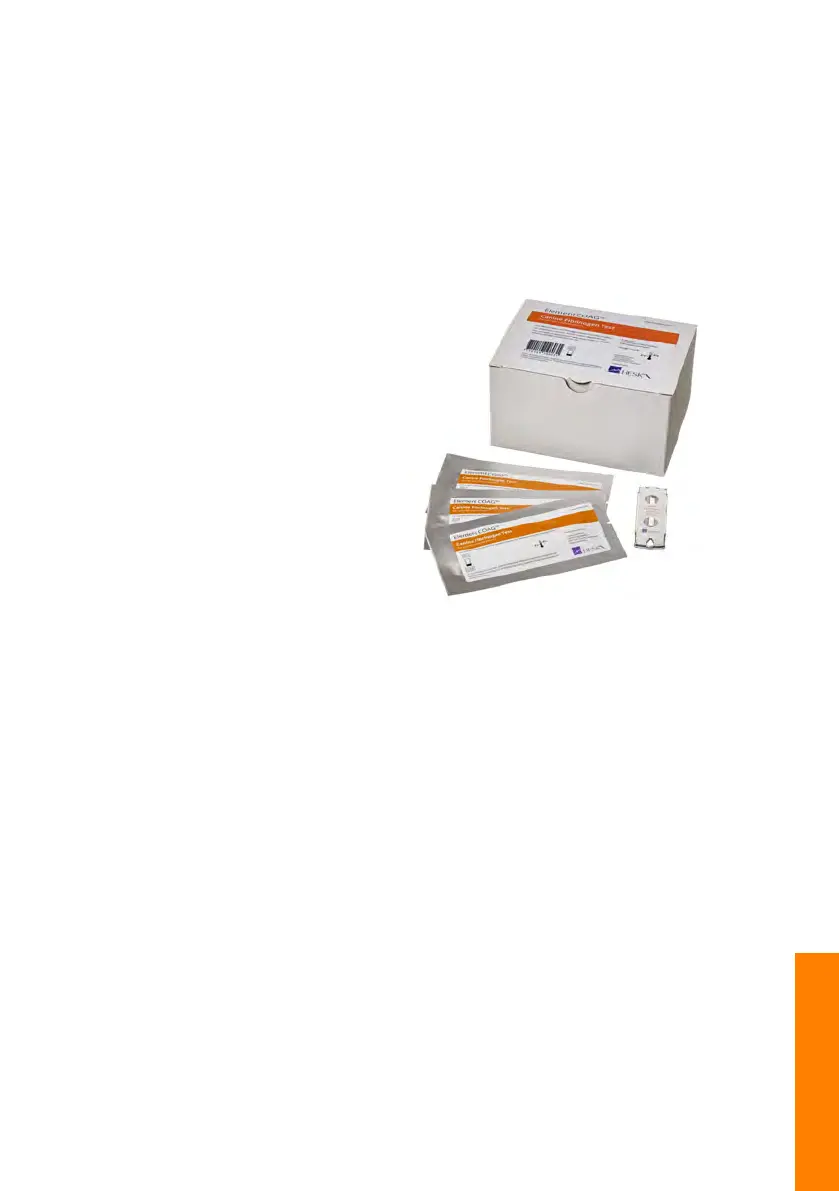
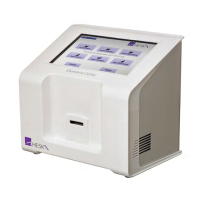
Figure 9.1:
Heska Element COAG
™
Ca-
nine Fibrinogen Test kit.
The Heska Element COAG
™
Canine Fib-
rinogen cartridge used with the Heska El-
ement COAG
™
Analyzer is designed to
measure the concentration of clottable fib-
rinogen in a canine (dog) plasma sample
using the Ellis–Stransky method.
Each Canine Fibrinogen cartridge con-
tains dual optical detection windows filled
with micro-channels.
The Canine Fibrinogen test cartridge mea-
sures the fibrinogen concentration from
100 µL
diluted plasma with nominal test
duration of approximately 10 minutes in-
cluding warm-up time.
9.1. Fibrinogen Testing
Fibrinogen (clotting factor I) is a coagulation protein produced by the liver and present in
plasma of all vertebrates [
18
,
19
]. It plays an important role in blood coagulation, cellular
interactions, inflammation and wound healing. Fibrinogen is also known as an acute
phase protein (APP) and has been widely used as a clinical indicator of acute or chronic
inflammation or tissue damage in mammals [18, 20–22].
The canine normal range of plasma circulated fibrinogen is
1.2 g/L
to
3.0 g/L
. When
evaluating canine fibrinogen level, age has to be taken into consideration: younger dogs
show slight but statistically significant higher fibrinogen level [23].
In response to ongoing inflammation, fibrinogen plasma concentration changes within
24 to 48 hours [
24
]. The function and quantity of plasma fibrinogen can be altered by
both inherited and acquired disorders [
25
]. Fibrinogen is an essential component of
the hemostatic process and its level may be increased in response to inflammation, or
reduced due to consumption [
26
]. Low plasma fibrinogen concentration can indicate a
systemic activation of the clotting system, where consumption of clotting factors is faster
than synthesis, with increased risk of bleeding as a consequence.
67


 To Next Page