9. Canine Fibrinogen Test
9.3. Test Requirements
9.3.1. Materials and Equipment
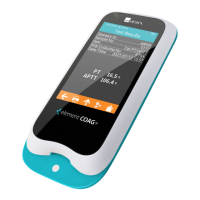
The following materials and equipment are required in order to perform a Canine Fibrino-
gen Test on the Heska Element COAG
™
Analyzer:
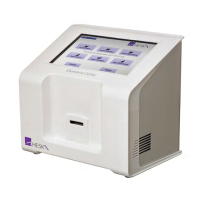
• Heska Element COAG
™
Analyzer
• Canine Fibrinogen Test Cartridge
• Pipette tip (included in the sealed pouch with the test cartridge)
• 100 µL fixed-volume pipette
• Pre-filled diluent tube (included in each box of cartridges)
• Syringes with a 22-gauge needle or larger
• Sample tubes containing 3.2 % or 3.8 % sodium citrate as an anticoagulant
• Package insert for Canine Fibrinogen Test cartridge
• Quick Guide for Canine Fibrinogen Test
• Centrifuge minimum 7000 g × minutes.
9.3.2. Centrifuge
Table 9.2
lists the required centrifugation time as a function of centrifuge radius and
revolutions per minute to obtain platelet-poor plasma as needed by the Canine Fibrinogen
Test.
Some centrifuges do not display the
g
-loading of the sample, but instead show the
revolutions per minute (RPM) of the centrifuge. In that case, use the table to find the
required centrifugation time for a given RPM and centrifuge radius
1
.
9.3.3. Sample Preparation
Use a syringe with a 22-gauge needle or larger when drawing the blood to avoid hemolysis.
Collect the blood directly into the test tube containing citrate as the anticoagulant. The
result of a Fibrinogen analysis is dependent on the quality of the blood sample and the
extracted plasma.
1
The centrifuge radius is the distance between the axis of rotation and the center of the test-tube when placed in the
centrifuge.
70


 To Next Page