11. Feline A, B and AB Blood Typing
include Birman, British Shorthair, Scottish Fold, Somali, and Sphynx. Somalis are more
likely than average to have the rare type AB blood [49].
11.1.2. Blood Transfusion Risks
Cats that are transfused, even once, with an incompatible blood type, are at risk for
a transfusion reaction. Cats with Type B blood exhibit an immediate and catastrophic
systemic anaphylactic reaction and a Hemolytic Transfusion Reaction (HTR) when
transfused with Type A blood, because of their natural high-titered anti-A antibody. As
an outcome death of the patient is extremely likely.
Cats with type A blood exhibit a natural low-titered anti-B antibody response when
transfused with type B blood. In this case, the reaction is mild but the transfused cells
will have a shortened life span. The recipient will develop moderate titers of anti-B
antibody that will result in a serious reaction if a subsequent incompatible transfusion is
administered [48].
11.1.3. Mating risks
Serious problems can also result from accidental or mismatched mating. A mating
of a type B queen with a type A tom will result in their type A kittens being at risk
for neonatal isoerythrolysis (“NI”), commonly known as “fading kitten syndrome”. The
maternal naturally occurring highly titered anti-A antibody occurs in the colostrum where
from it can be absorbed by the newborn kittens. The absorbed antibody attacks the
kittens’ type A erythrocytes. Although the kittens can seem normal at birth, they develop
signs after nursing, fade and die within the first days of life. Determining the blood type
of the queen and the tom prior to mating, coupled with appropriate genetic counseling,
can minimize the risk of NI. Furthermore, immediate blood type determination of the
newborn kittens will alert the client to remove the kittens and to begin surrogate nursing
where necessary [48].
11.2. Test Specifications
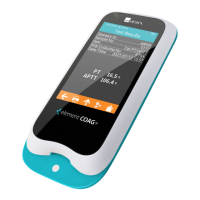
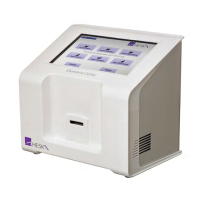
The Feline Blood Typing test cartridge used with the Heska Element COAG
™
Analyzer
is intended for use to classify cats as A positive, B positive, or A and B positive. Test
results obtained under normal operating conditions have an accuracy of 99.31 %.
All components of the test kit are stable at refrigerated temperatures (
36 °F
to
77 °F
or
2
◦
C
to
25
◦
C
). Kits and components should not be exposed to direct sunlight. Once
warmed to room temperature, the cartridge must be used within that day and should not
be returned to the refrigerator.
88


 To Next Page