Chapter 9
9.3. Test Requirements
Table 9.2:
Centrifugation time for combinations of centrifugation speed and centrifuge
radius.
Radius RPM Acc. Time Radius RPM Acc. Time
[cm] [1/min] [g] [min] [cm] [1/min] [g] [min]
2.5 5000 698 11 7.5 7000 4104 2
2.5 6000 1005 7 7.5 8000 5360 2
2.5 7000 1368 6 7.5 9000 6784 2
2.5 8000 1787 4 7.5 10 000 8375 1
2.5 9000 2261 4 10.0 2000 447 16
2.5 10 000 2792 3 10.0 3000 1005 7
5.0 5000 1396 6 10.0 4000 1787 4
5.0 6000 2010 4 10.0 5000 2792 3
5.0 7000 2736 3 10.0 6000 4020 2
5.0 8000 3574 2 10.0 7000 5472 2
5.0 9000 4523 2 10.0 8000 7147 1
5.0 10 000 5584 2 10.0 9000 9045 1
7.5 5000 2094 4 10.0 10 000 11 167 1
7.5 6000 3015 3
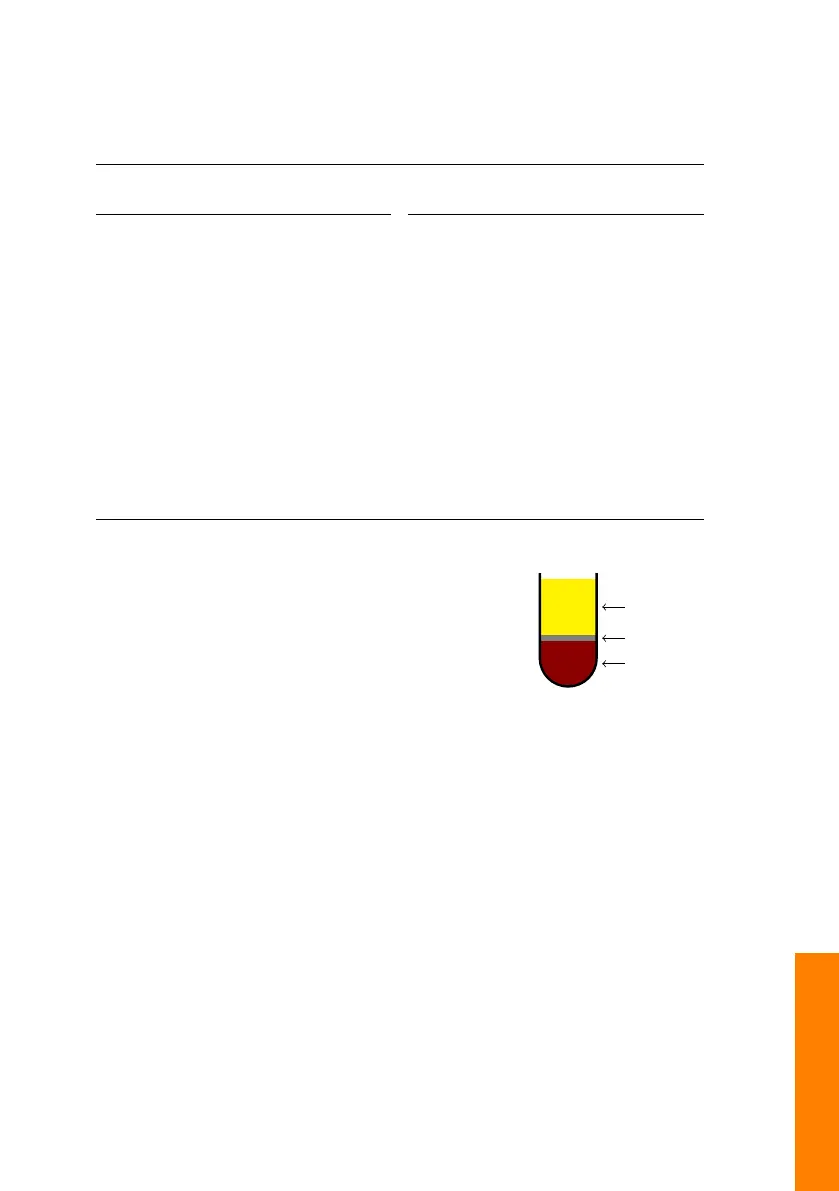
Plasma
Buffy coat
Red blood cells
Figure 9.2:
Whole blood
sample after centrifugation.
To extract platelet-poor plasma from the whole blood sam-
ple, centrifuge the whole blood in a centrifuge for minimum
7000 g × minutes
. The rotation speed and necessary spin
time is dependent on the centrifuge size. Please refer to
Table 9.2 for minimum centrifuge requirements.
Centrifugation will separate the Red Blood Cells (RBC)
from the plasma, see
Figure 9.2
for a schematic represen-
tation of a sample tube after centrifugation. Make sure
to collect plasma for the Canine Fibrinogen Test from the
upper part of the plasma in the tube to avoid contaminating
the plasma with RBCs.
Other than centrifugation, no special sample preparation is needed before initiating the
Canine Fibrinogen Test. As part of the test procedure, the extracted platelet-poor plasma
must be diluted in accordance with the on-screen instruction on the Heska Element
COAG
™
Analyzer.
Follow standard blood-drawing procedures at all times and pay special attention to the
following:
•
Contamination from thromboplastin, alcohol and intravenous solutions will interfere
with the fibrinogen assay. Hemolysis and foaming of the blood sample are potential
71


 To Next Page