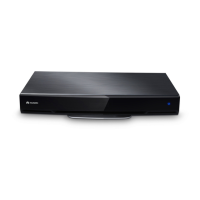
TE20 Videoconferencing Endpoint
Huawei Proprietary and Confidential
Copyright © Huawei Technologies Co., Ltd.
to participate on the Internet network. DHCP also provides a mechanism for
allocating IP addresses to hosts.
See File Transfer Protocol over SSL.
File Transfer Protocol
over SSL (FTPS)
An extension to the commonly used File Transfer Protocol (FTP) that adds support
for the Transport Layer Security (TLS) and the Secure Sockets Layer (SSL)
cryptographic protocols.
Audio codec standard that uses adaptive differential pulse-code modulation
(ADPCM). Its data rate is 48 kbit/s, 56 kbit/s, or 64 kbit/s.
Compared with H.263, H.264 can provide the same-quality video at half of the bit
rate, with strong error resilience characteristics.
high definition multimedia interface
See Hypertext Transfer Protocol.
See Hypertext Transfer Protocol Secure.
Hypertext Transfer
Protocol (HTTP)
An application-layer protocol used for communications between web servers and
browsers or other programs. HTTP adopts the request-response mode. A client sends
a request to the server. The request consists of two parts: request header and
MIME-like message. The request header contains request method, uniform resource
locator (URL), and protocol version. The MIME-like message contains request
modifiers, client information, and possible body content. Upon receiving the request,
the server responds with a status line. The status line includes the message's protocol
version, a success or error code, and a MIME-like message, which contains server
information, entity meta-information, and possible entity-body content. For details
about HTTP, see RFC2616.
Hypertext Transfer
Protocol Secure
(HTTPS)
An HTTP protocol that runs on top of transport layer security (TLS) and Secure
Sockets Layer (SSL). It is used to establish a reliable channel for encrypted
communication and secure identification of a network web server. For details, see
RFC2818.



 To Next Page