All trucks
Technical Handbook
Hydraulic Cylinders
Service
9279 02-09
Publ. Gr. S.
770
The function and removal of seals
Piston rod seals
The piston rod seal is the seal that sits in a groove in the hydraulic
cylinder head forming a seal against the piston rod. This seal is
very exposed as it performs both dynamic and static sealing func-
tions, i.e., it is seals against the moving surface of the piston rod
whilst the sealing surface against the cylinder head is static.
There are different types of piston rod seals:
z
Single V seals
z
Pre-tensioned V seals with support ring
z
Compressible seals
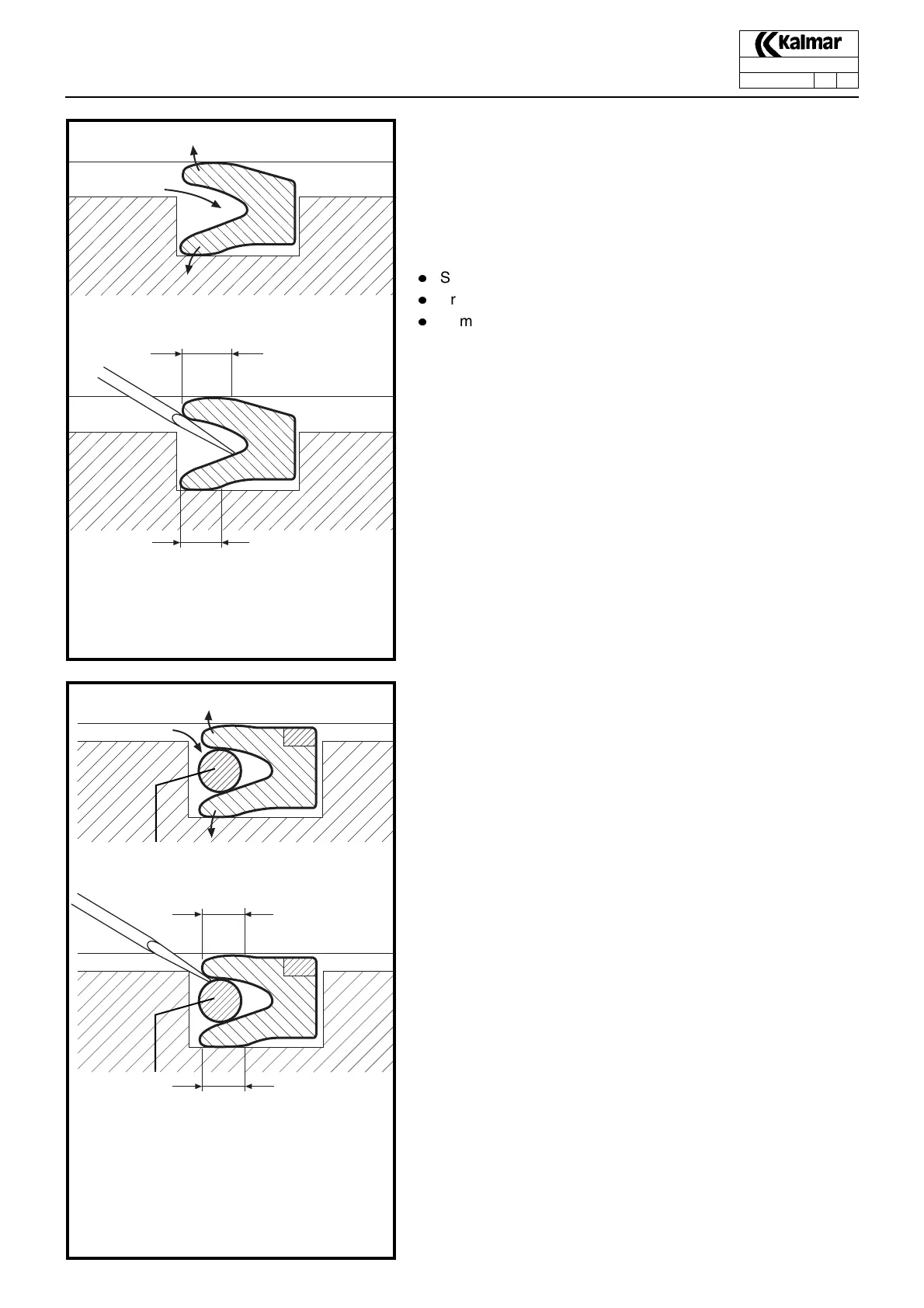
The single V seal
has a V shaped section with two lips which
seal in each respective direction. The hydraulic pressure works it-
self into the V shape and presses the sealing lips outwards
against the sealing surface of the piston rod and in the cylinder.
Even the smallest amount of damage to the sealing lips can
cause a major leakage. Check the sealing lips by carefully feeling
around the seal with a finger nail.
Use a screwdriver to remove a V seal, see illustration. Lever out
and twist up the seal. It is extremely important that the screwdriv-
er only comes into contact with the inside of the V shape so that
it cannot touch and thereby damage any sealing surface. A score
from a screwdriver on the sealing surface will have a disastrous
effect and cause major leakage.
The pre-tensioned V seal
has, in addition, an O ring within the
space formed by the V shape. The O ring provides a greater seal-
ing effect at low hydraulic pressure as the O ring, even when not
under hydraulic pressure, presses the sealing lips out against the
sealing surfaces. It is equally sensitive to damage as the V seal.
Check the seal in the same way.
Use a screwdriver to remove the seal, see illustration. Lever out
and twist up the seal. It is extremely important that the screwdriv-
er only comes into contact with the inside of the V shape so that
it cannot touch and thereby damage any sealing surface. A score
from a screwdriver on the sealing surface will have a disastrous
effect and cause major leakage.
KL1008
1
2
3
4
6
5
1. Hydraulic pressure
2. Sealing lip pressed out against piston rod
3. Sealing lip pressed in against cylinder head
4. Sealing surface, piston rod
5. Sealing surface, cylinder head
6. Screwdriver
KL1009
2
1
3
4
5
6
7
1. Hydraulic pressure
2. Sealing lip pressed out against piston rod
3. Sealing lip pressed in against cylinder head
4. Sealing surface, piston rod
5. Sealing surface, cylinder head
6. Screwdriver
7. O ring
7



 To Next Page