DCE80-100E
Technical Handbook
Lifting mast and fork carriage
Service
11
P.Group 80
TDCE01
04GB
Inserting shims for sliding plates - general
1. Check the play in the mast and between the carriage and the
mast.
2. When a noticeable gap occurs, equivalent to a play of at
least 2 mm, reduce the play with shims.
3. When inserting the last shim, the sliding plates should have
at least 5 mm wearing surface remaining, if this is not the
case, they should be replaced.
Inserting shims for the upper sliding plate in the
attachment mounting
See the “Carriage sliding plates” illustration.
1. Shim 5 has a fixing slot, making attachment removal unnec-
essary when inserting additional shims.
2. Remove holding plate 6.
3. Loosen the sliding plate fixing screws so that the sliding plate
loosens from the carriage.
4. Slide in the required shim to adjust/remove the gap between
attachment and carriage.
5. Replace the holding plate and secure the sliding plate in
place.
Bleeding the lift cylinders
1. Use a hydraulic lift or similar.
2. When the mast is fitted, raise the inner mast approx. 0.3 m.
3. Connect a tube to each of the bleed nipples at the top of
each cylinder to collect any spill fluid, in a suitable container.
4. Open the bleed nipples on each of the lift cylinders, until all
air has been evacuated.
5. Re-tighten the bleed nipples.
Stretching of hoses
1. After a certain amount of use, the hoses will become
stretched and will therefore need to be tightened.
2. Stretch the hoses by loosening the hose holder from the car-
riage and move them down to a suitable new hole profile on
the carriage. See the “High-Lift Mast” illustration.
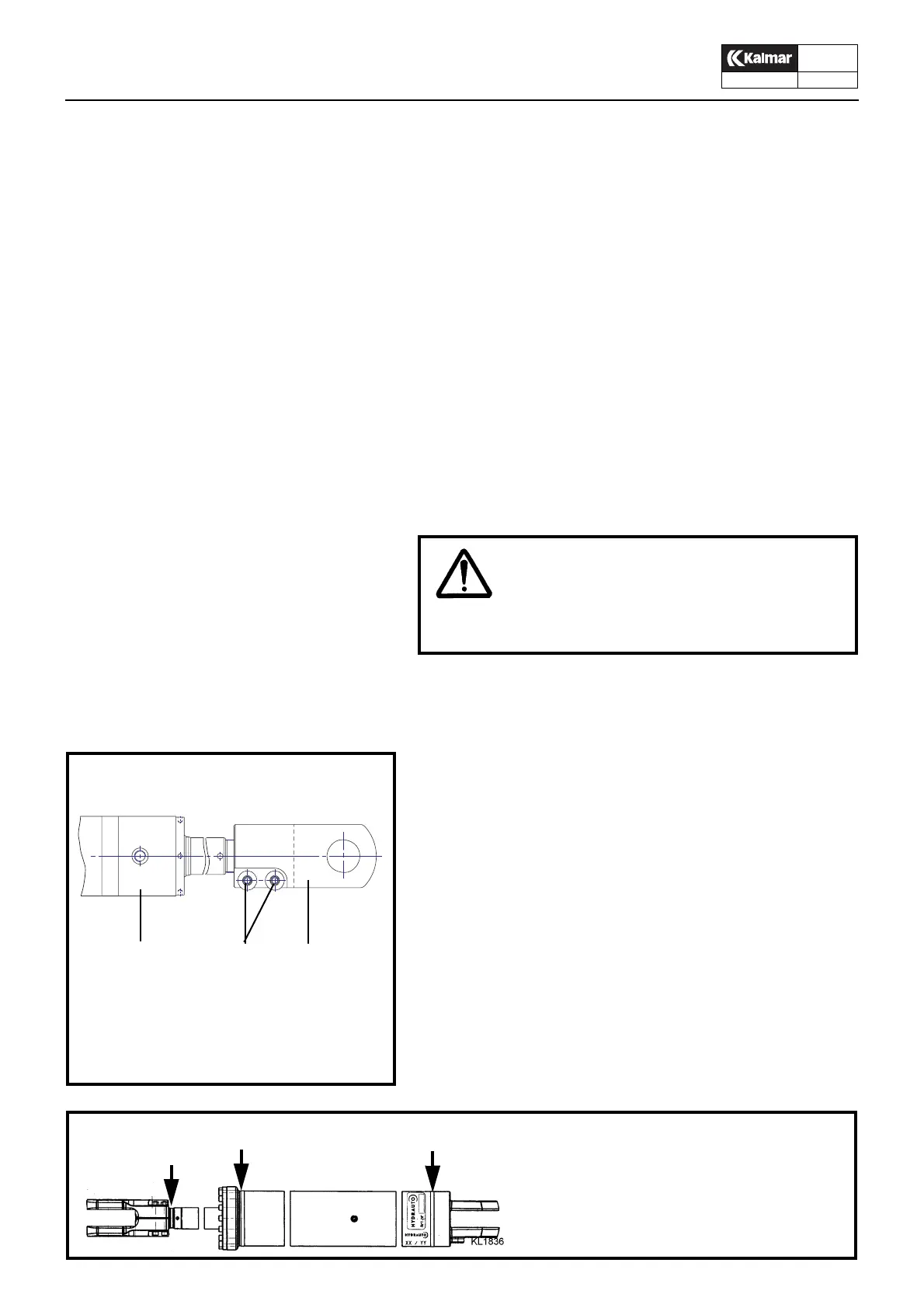
Tilt cylinder mounting, tightening torque
1. After any adjustment of the tilt angle, the piston rod head’s
mounting bolt should be tightened to a torque of 136 Nm.
See adjacent illustration.
Checking tilt cylinders
The tilt cylinders should be checked every 500 hours considering
på cracks and also tightening torque as stated above.
4. Check to make sure that no cracks occur at welds and fillets.
Pay special attention to the items in the illustration below.
WARNING!
Risk for injury!
During the bleeding of the cylinders the inner mast and
carriage will lower. Ensure that nobody is in the way!
KL1127
1
2
3
1. Tilt cylinder
2. Mounting bolts
3. Piston rod head
Risk of crack formation
1. Thread exit
2. Weld
3. Weld
1
2
3



 To Next Page