EasyManua.ls Logo

KTM 400/620 LCA - Kondensator Prüfen; Equipaggiamento Elettrico; Controllo Condensatore; Contróle du Condensateur

KTM 400/620 LCA
106 pages
Print Icon
To Next Page IconTo Next Page
To Previous Page IconTo Previous Page
Loading...
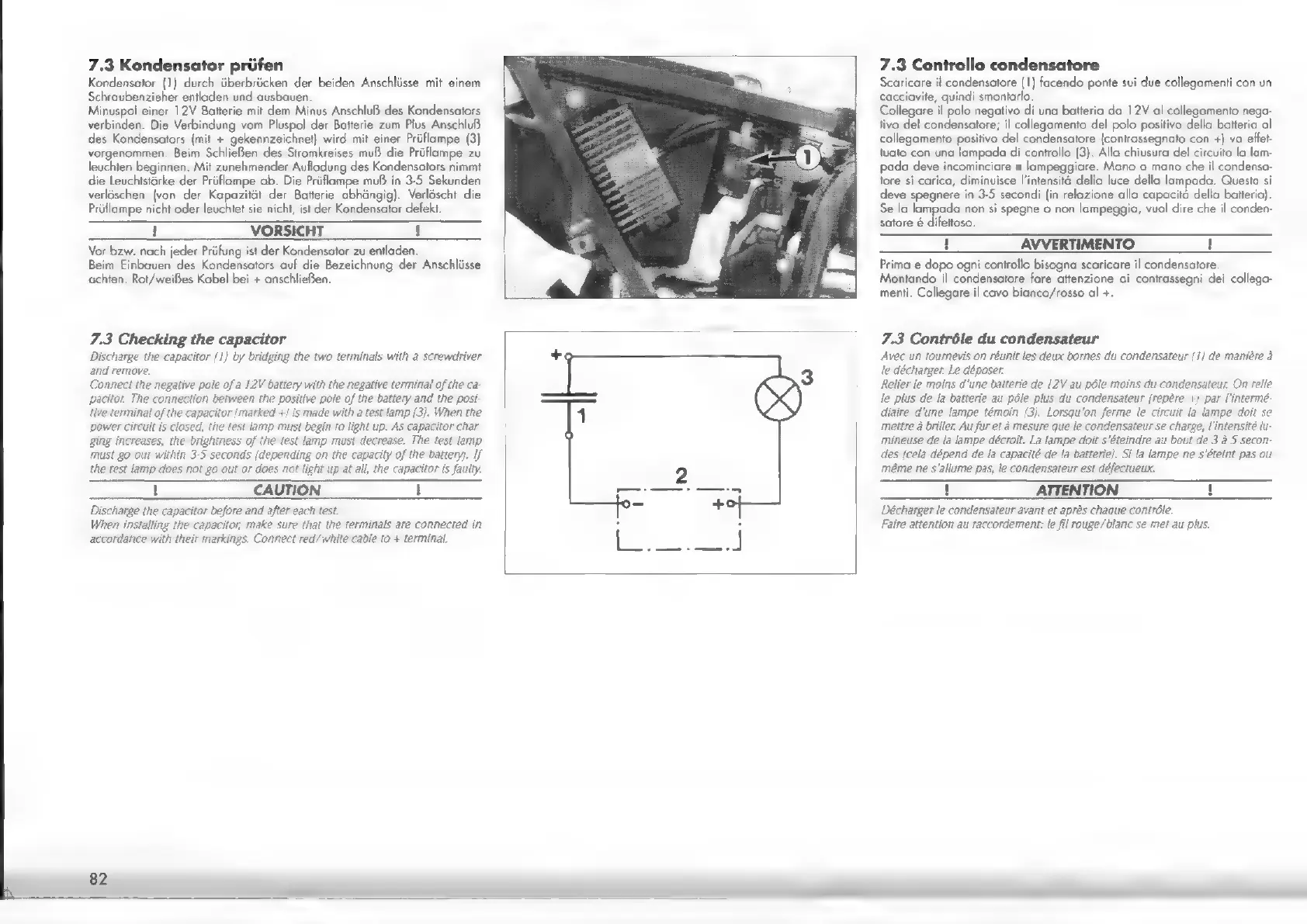
7.3
Kondensator
prüfen
Kondensator
(1)
durch
überbrücken
der
beiden
Anschlüsse
mit
einem
Schraubenzieher
entladen
und
ausbauen.
Minuspol
einer
12V
Batterie
mit
dem
Minus
Anschluß
des
Kondensators
verbinden.
Die
Verbindung
vom
Pluspol
der
Batterie
zum
Plus
Anschluß
des
Kondensators
[mit
+
gekennzeichnet)
wird
mit
einer
Prüflampe
(3)
vorgenommen.
Beim
Schließen
des
Stromkreises
muß
die
Prüflampe
zu
leuchten
beginnen.
Mit
zunehmender
Aufladung
des
Kondensators
nimmt
die
Leuchtstárke
der
Prüflampe
ab.
Die
Prüflampe
muß
in
3-5
Sekunden
verlöschen
(von
der
Kapazität
der
Batterie
abhängig).
Verlöscht
die
Prüflampe
nicht
oder
leuchtet
sie
nicht,
ist
der
Kondensator
defekt.
!
VORSICHT
!
Vor
bzw.
nach
jeder
Prüfung
ist
der
Kondensator
zu
entladen.
Beim
Einbauen
des
Kondensators
auf
die
Bezeichnung
der
Anschlüsse
achten.
Rot/weißes
Kabel
bei
+
anschließen.
7.3
Checking
the
capacitor
Discharge
the
capacitor
{1}
by
bridging
the
two
terminals
with
a
screwdriver
and
remove.
Connect
the
negative
pole
ofa
12V
battery
with
the
negative
terminal
of
the
ca-
pacitor
The
connection
between
the
positive
pole
of
the
battery
and
the
posi-
tive
terminal
of
the
capacitor
{marked
+}
is
made
with
a
test
lamp
(3).
When
the
power
circuit
is
closed,
the
test
lamp
must
begin
to
light
up.
As
capacitor
char
ging
increases,
the
brightness
of
the
test
lamp
must
decrease.
The
test
lamp
must
go
out
within
3-5
seconds
(depending
on
the
capacity
of
the
battery).
If
the
test
lamp
does
not
go
out
or
does
not
light
up
at
all,
the
capacitor
is
faulty.
H
CAUTION
1
Discharge
the
сарасйог
before
and
after
each
test.
When
installing
the
capacitor,
make
sure
that
the
terminals
are
connected
in
accordance
with
their
markings.
Connect
red/white
cable
to
+
terminal.
7.3
Controllo
condensatore
Scaricare
il
condensatore
(1)
facendo
ponte
sui
due
collegamenti
con
un
cacciavite,
quindi
smontarlo.
Collegare
il
polo
negativo
di
una
batteria
da
12V
al
collegamento
nega-
tivo
del
condensatore;
il
collegamento
del
polo
positivo
della
batteria
al
collegamento
positivo
del
condensatore
{contrassegnato
con
+)
va
effet
tuato
con
una
lampada
di
controllo
(3).
Alla
chiusura
del
circuito
la
lam-
pada
deve
incominciare
a
lampeggiare.
Mano
a
mano
che
il
condensa-
tore
si
carica,
diminuisce
l'intensità
della
luce
della
lampada.
Questa
si
deve
spegnere
in
3-5
secondi
(in
relazione
alla
capacità
della
batteria).
Se
la
lampada
non
si
spegne
o
non
lampeggia,
vuol
dire
che
il
conden-
satore
&
difettoso.
H
AVVERTIMENTO
1
Prima
e
dopo
ogni
controllo
bisogna
scaricare
il
condensatore.
Montando
il
condensatore
fare
attenzione
ai
contrassegni
dei
collega-
menti.
Collegare
il
cavo
bianco/rosso
al
+.
7.3
Contrôle
du
condensateur
Avec
un
tournevis
on
réunit
les
deux
bornes
du
condensateur
{1}
de
manière
à
le
décharger
Le
déposer
Relier
le
moins
d'une
batterie
de
12V
au
pôle
moins
du
condensateur
On
relie
le
plus
de
la
batterie
au
pôle
plus
du
condensateur
(repére
+)
par
l'intermé-
diaire
d'une
lampe
témoin
(3j.
Lorsqu'on
ferme
le
circuit
la
lampe
doit
se
mettre
à
briller.
Au
fur
et
à
mesure
que
le
condensateur
se
charge,
l'intensité
lu-
mineuse
de
la
lampe
décroit.
La
lampe
doit
s'éteindre
au
bout
de
3
à
5
secon-
des
{cela
dépend
de
la
capacité
de
la
batterie).
Si
la
lampe
ne
s'éteint
pas
ou
méme
ne
s'allume
pas,
le
condensateur
est
défectueux.
!
ATTENTION
Décharger
le
condensateur
avant
et
après
chaque
contrôle.
Faire
attention
au
raccordement:
le
fil
rouge/blanc
se
met
au
plus.

Table of Contents