[HST type]
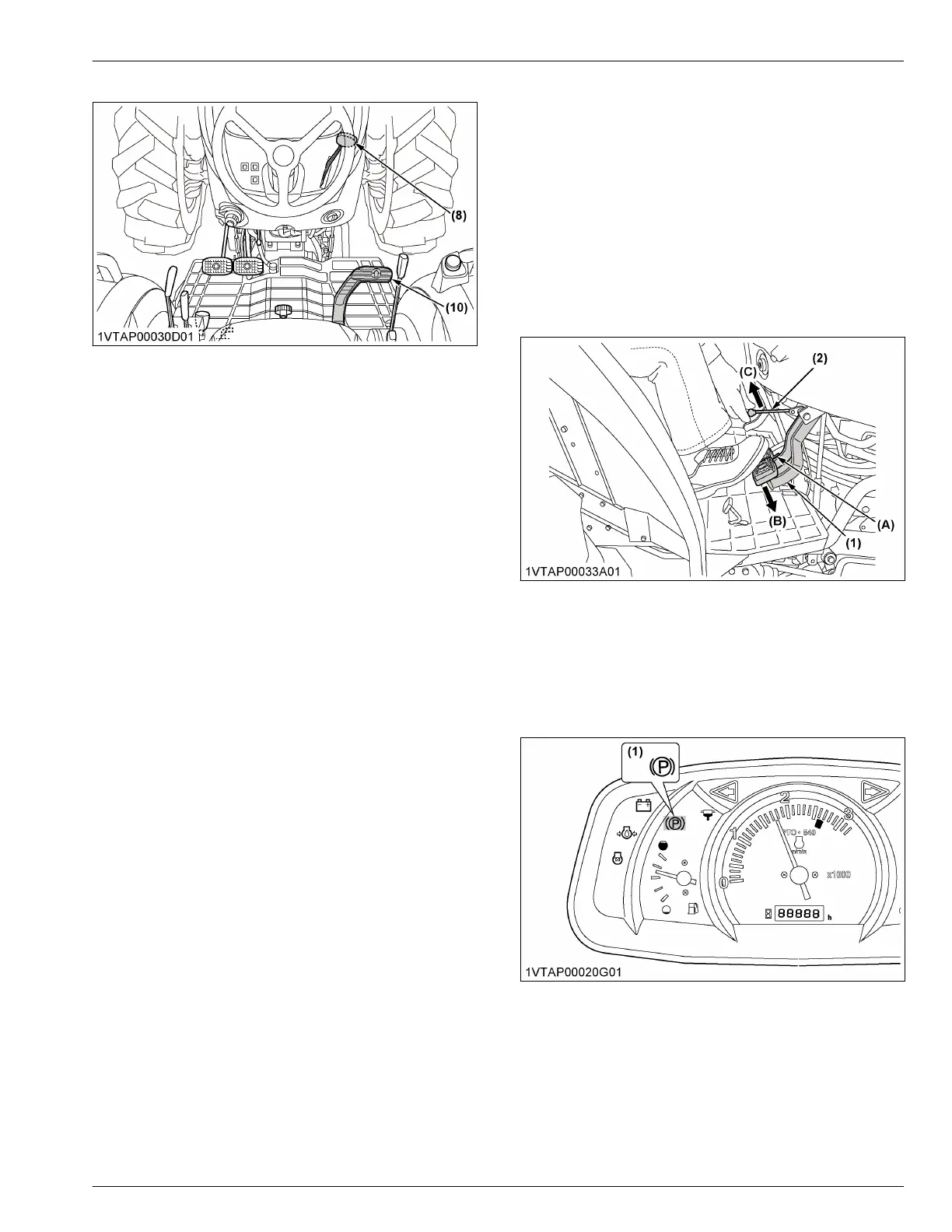
(8) Hand throttle lever (10) Speed control pedal
4. Tips on diesel particulate filter
(DPF) regeneration
• Operation
The higher in speed or load the engine operates,
the higher the exhaust temperature rises. As a
result, particulate matter (PM) inside the DPF is
consumed, therefore the regeneration process is
required less frequently over time.
The lower in speed or load the engine operates, the
lower the exhaust temperature. Accordingly, less
particulate matter (PM) inside the DPF is consumed
and more accumulation of PM will occur, which
requires frequent regeneration. Therefore, avoid
prolonged idling if possible.
• Necessary conditions for regeneration
When the following conditions are all satisfied,
regeneration will start. However, even if one of the
following conditions is not met during the
regeneration process, the regeneration process will
be interrupted and not be completed.
– The engine coolant temperature.
– The DPF temperature.
– The engine speed is 1200 rpm or higher.
• Usually it takes 15-20 minutes to complete the
regeneration cycle.
Actual regeneration time may depend on ambient
temperature, exhaust temperature and engine
speed.
• It is recommended to perform the regenerating
while the engine is warm.
• Do not unnecessarily start and interrupt the
regeneration process. Otherwise, a small amount of
fuel becomes mixed with the engine oil, which
degrades the oil quality.
• While the DPF is being regenerated, the air-flow-
rate of engine is automatically limited to keep up
the exhaust temperature. Because of limit of the air-
flow-rate of engine, the engine may sound
differently, but this sound is normal for this engine.
• Just after the regeneration has ended, the DPF
muffler remains hot. It is advisable to keep the
engine running for about 5 minutes to allow cooling
of the exhaust components.
STARTING THE ENGINE
[MANUAL TRANSMISSION
TYPE]
1. Make sure that the parking brake is set.
(See To set the parking brake on page 44 if the
parking brake is not set)
(1) Brake pedal
(2) Parking brake lever
(A) Interlock the brake pedals
(B) Depress
(C) Pull
NOTE :
• The parking-brake-indicator in the Easy
Checker
™
comes on while the parking brake
is applied.
(1) Parking brake indicator
EXHAUST AFTERTREATMENT DEVICES OPERATING THE ENGINE



 To Next Page