WRS – Installation Manual
2. Channel switching conditions
The ACS system analyses the local environment continuously, and changes the channel only when
absolutely necessary. The conditions that may cause it to switch channel are as follows:
A. Cycle error
If the system terminates a measurement cycle abruptly, causing the machine to stop running and generate
the ERROR signal, it is necessary to try changing the channel; when the next measurement cycle starts, the
system will change the transmission channel so that the measurement cycle is performed using a channel at
a more secure frequency. Upon completion of the cycle, the WRP transmitter and WRI receiver evaluate the
quality of the connection and, if it is acceptable, the "provisional" cycle is checked again during the next
measurement cycle. After three consecutive measurement cycles where the evaluated connection quality is
acceptable, the channel change is confirmed and activated as the new working channel. Only at this point
does the display reading change permanently, indicating the new channel setting.
B. Noise and interference during a cycle
Even in the absence of any communication interference, the ACS system may decide to sample another
channel as an alternative to the one currently in use. This happens when the connection quality was
particularly low during the previous measurement cycle and the WRI receiver detected a high level of
interference when it was not in use in the measurement cycle. Note that both conditions must be true in order
for the system to search for an alternative channel, so as to avoid switching channels in the event of a
temporary drop in quality due to the distance between the WRP transmitter and the WRI receiver.
C. Invasion by another WRS
The last condition that may cause the system to switch channels is known as an "invasion", where two (or
more) WRS systems have been tuned to the same channel and sub-channel by mistake. This condition is
dangerous and must be avoided; in fact, the WRS checks the connection using a special safety algorithm at
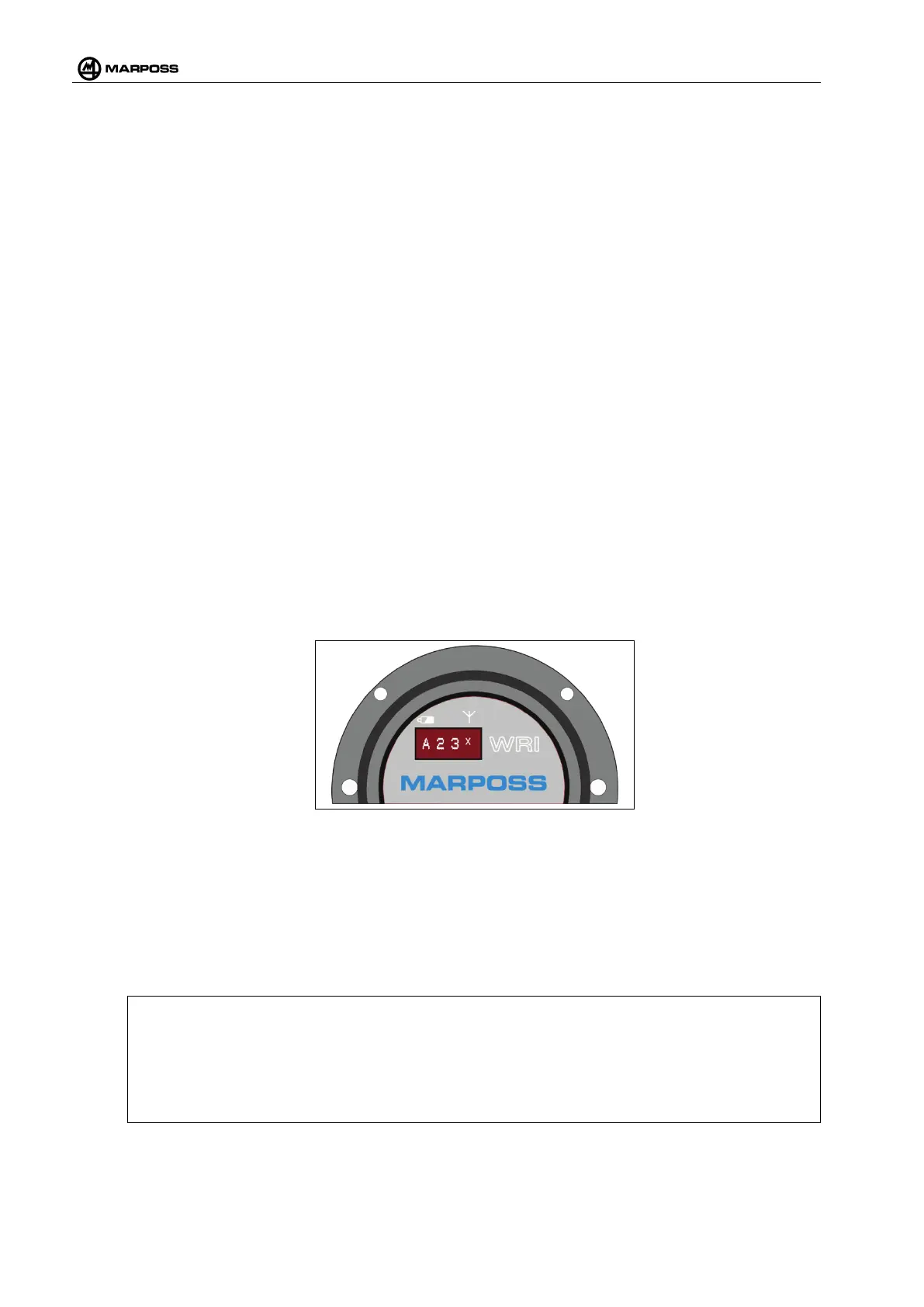
the beginning of the cycle, and interrupts the operation if necessary. This condition is indicated by an "X" on
the WRI receiver display (see Figure 4-37).
Figure 4-37. WRI receiver display panel.
If the ACS system is disabled, the measurement cycle will not start until the channel is free; otherwise, the
ACS system will change the channel. If the connection quality of the new channel is very good, it is selected
permanently as the new channel setting. Note that the “invasion” information expires automatically after
approx 5s; therefore, if two machines are tuned to the same frequency channel and sub-channel, but are
never operated simultaneously, there will be no invasion, and hence no interruption of the cycle. In reality, in
automated installations, such as a "transfer” type line, this represents an intelligent way of exploiting the
available channels.
[
N.B.:
Placing t
he WRP transmitter probe in the tool magazine without deactivating the connection may
result in the connection being interrupted and the system attempting to change the channel; if it is
not possible to deactivate the WRP transmitter before it exits the wo
rking area, the ACS system
must be disabled, given
that the weak signal condition cannot be improved by simply changing the
frequency channel.



 To Next Page