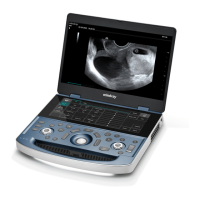
iScanHelper A-1
Appendix A iScanHelper
By providing the referential information, such as, the ultrasonic image, the anatomic graphic,
scanning pictures/other scanning tips or diagnosis comments, the system helps the doctors
to operate the scanning by iScanHelper. Furthermore, it is a good platform for the self-
learning and training of ultrasound scanning technique for doctors. The system also plays a
role in the assistant software system in fulfilling training and education.
Tips: iScanHelper feature is available under abdominal, urological, Gynecology, obstetrics,
and small parts exam modes.
THIS “iScanHelper” IS FOR REFERENCE OR TUTORIAL PURPOSES ONLY,
AND THE MANUFACTURER WILL NOT BE LIABLE FOR DAMAGES AND/OR
OTHER UNDESIRABLE CONSEQUENCE IN ANY KIND THAT MAY OCCUR TO
THE PATIENT OR THE USERS BY USING THE SOFTWARE.
A.1 Enter/ Exit
◼ Enter
Press the user-defined key for entering iScanHelper (setting path: [Setup] (F10) →
[System Setup] → [Key Config.]).
◼ Exit
Press the user-defined key again to exit iScanHelper.
A.2 Use iScanHelper for Reference
1. Perform ordinary scanning procedure.
2. Press the user-defined key for entering iScanHelper to enter iScanHelper status.
3. Rotate the trackball to move the cursor onto the target view name in the view selecting
box and then press <Set>.
4. Perform scanning according to information displayed on the help information area.
You can zoom in a single window in the help information area to see the window more
clearly. For details, please refer to “A.4.3 Single/quad-window Display”.
5. Press the user-defined key for entering iScanHelper again to exit.
A.3 Use iScanHelper for Learning or
Training
1. Switch to the exam modes that support iScanHelper.
2. Press the user-defined key for entering iScanHelper to enter iScanHelper status.
3. Learn and practise views by system defaulted sequence according to the information
displayed on help information area; or select unfamiliar views to practise.
You can zoom in a single window in the help information area to see the information. For
details, please refer to “A.4.3 Single/quad-window Display”.


 To Next Page