
 Need help?
Do you have a question about the Multitel MX 250 and is the answer not in the manual?
Details about the manufacturer, branches, and contact information.
Information presented on the machine's identification plate.
Declaration of compliance with EU directives and standards.
Details identifying the manual, including document type and title.
Overview of the machine's design and compliance with EC directives.
Explains the purpose and content of the technical documentation provided.
Identifies the intended audience for this manual.
Describes the organization and layout of the manual for user guidance.
Provides guidance on how to effectively utilize the manual's content.
Recommendations for the machine buyer regarding documentation and training.
Recommendations for machine users on proper operation and compliance.
Definitions of technical terms used throughout the manual.
Outlines the process for updating the manual's content.
Lists directives followed during machine design, construction, and installation.
Defines key terms related to safety areas (Work Area, Dangerous Area, Control Area).
Classifies personnel (operators, technicians) and their required qualifications.
Identifies and describes risks that remain after safety measures are applied.
Specifies the required personal protective equipment for safe operation.
Information on noise levels and necessary protective measures.
Describes the machine's vibration transmission characteristics.
Details the machine's compliance with EMC regulations.
Provides overall safety instructions and precautions for machine use.
Safety guidelines for maintaining distances from ground hazards.
Specific safety warnings for tasks involving vegetation.
Safety precautions for sanding and renovation work.
Outlines the duties and responsibilities of personnel using the machine.
Lists forbidden operations, modifications, and conditions of use.
Specifies the authorized operations and work environments for the machine.
Procedures for handling operations outside standard intended use.
Explains the meaning and importance of safety signs on the machine.
Visual identification and location of safety pictograms.
Lists and describes the safety systems installed on the machine.
Safety procedures and minimum distances for working near electrical lines.
Information on optional insulation features and their limitations.
Factors affecting machine stability and visibility in specific conditions.
Terms and conditions of the machine's warranty.
Defines the manufacturer's release from responsibility for improper use.
Details on how to obtain technical assistance and order spare parts.
The primary purpose and function of the aerial work platform.
Description of the control stations for operators.
Identification of zones posing a risk during machine operation.
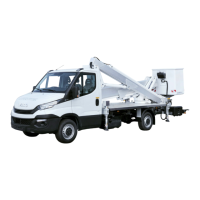
Identification and brief description of the machine's primary components.
Information on optional equipment available for the machine.
Specifications and technical data for the machine.
Physical dimensions and layout measurements of the machine.
Graphical representation of the machine's operational work areas.
Information regarding the footprint created by the stabilizers.
Guidelines and precautions for transporting the machine safely.
Procedures and safety measures for loading and unloading the machine.
Instructions for safely parking the machine.
Controls for operating the outrigger systems.
Operation of the outrigger crosspiece extensions.
Functionality of the optional automatic outrigger deployment system.
Controls located in the operator's basket for machine operation.
Controls located at ground level for machine operation.
Different types and features of optional ground control stations.
Reference to optional controls detailed in annexes.
Step-by-step instructions for starting the machine.
Procedures for securing the machine on the ground.
Detailed steps for extending and deploying the outriggers.
Methods for ensuring the carriage is level.
Using the spirit level to check carriage inclination.
Functionality of the optional electronic spirit level for carriage leveling.
Verifying that the machine is stable and correctly positioned.
Step-by-step instructions for operating the machine's functions.
Procedure for raising the operator basket to the work position.
Steps to safely lower and retract the machine for transport or storage.
Operation and importance of the device preventing over-extension.
Description of the load sensing system's function.
Troubleshooting steps for common operational issues.
Steps to take if basket controls become inoperative.
Steps to take if base controls become inoperative.
Troubleshooting for combined control system failures.
Troubleshooting steps for power supply failures.
Procedure for safely lowering the operator during emergencies.
Instructions for safely stopping the machine's operations.
Steps to follow when finishing work and shutting down the machine.
Procedure for activating the emergency stop button.
Essential safety measures to observe during maintenance tasks.
Overview of general maintenance procedures and practices.
Scheduled maintenance tasks for regular upkeep.
A table detailing routine maintenance operations and their frequencies.
Specific checks to be performed monthly and recorded.
Detailed monthly checks for the outrigger components.
Verifying the PTO indicator light function.
Procedure for checking hydraulic oil levels.
Using the spirit level to check carriage inclination and outrigger positioning.
Checking the integrity of the seals on the supporting jacks.
Verifying the function of the boom raised consent indicator light.
Testing the locking mechanism when the boom is raised.
Specific inspections for the boom and its sliding blocks.
Inspecting side sliding blocks for proper fit and play.
Verifying the condition and fastening of supporting sliding blocks.
Checking the functionality of the optional 230V socket.
Testing the emergency lowering function.
Testing the optional electric pump or motor.
Testing the emergency stop button for correct operation.
Inspecting seals on various components for integrity.
Inspections related to the operator's basket.
Testing all basket movement controls for proper function.
Testing the emergency stop button within the basket.
Checking the automatic leveling system of the basket.
Lubrication procedure for specific gate hinges on the baskets.
General inspection points for the machine.
Verifying the tightness of various bolts using a torque wrench.
Identifying and rectifying any oil leaks in the hydraulic system.
Verifying the correct functionality of the extension limiting device.
Ensuring boom head limit switches are securely fastened.
Confirming legibility and correct placement of labels and warnings.
Checking the oil filter's condition and replacing it if necessary.
Annual maintenance tasks performed by qualified technicians.
Procedures for complex maintenance requiring specialized skills.
Guidance on maintaining the checks logbook.
Guidelines for storing the machine during non-operational periods.
Procedures for the safe dismantling and disposal of the machine.
List of supplementary documents and appendices.
References to manuals from component manufacturers.
 General
| Brand | Multitel |
|---|---|
| Model | MX 250 |
| Category | Industrial Equipment |
| Language | English |

 To Next Page