Operation
4
20
Sample Types
Because of the difference in combustion charac-
teristics of the many different materials which may
be burned in an oxygen combustion vessel, it is
difficult to give specific directions which will assure
complete combustions for all samples.
The following fundamental conditions should be
considered when burning samples:
• Some part of the sample must be heated to its
ignition temperature to start the combustion
and, in burning, it must liberate sufficient heat
to support its own combustion regardless of the
chilling effect of the adjacent metal parts.
• The combustion must produce sufficient tur-
bulence within the combustion vessel to bring
oxygen into the fuel cup for burning the last
traces of the sample.
• A loose or powdery condition of the sample
which will permit unburned particles to be
ejected during a violent combustion.
• The use of a sample which contains coarse
particles will not burn readily. Coal particles
which are too large to pass a 250 μm (60 mesh)
screen may not burn completely.
• The use of a sample pellet which has been made
too hard or too soft can cause spalling and the
ejection of unburned fragments.
• The bottom of the cup should always be at least
one-half inch above the bottom of the combus-
tion vessel or above the liquid level in the vessel
to prevent thermal quenching.
• If the moisture, ash and other non combustible
material in the sample totals approximately
20% or more of the charge, it may be difficult
to obtain complete combustion. This condition
can be remedied by adding a small amount of
benzoic acid or other combustion aid.
Foodstuffs and Cellulosic Materials
Fibrous and fluffy materials generally require one of
three modes for controlling the burn rate. Fibrous
materials do not pelletize readily and generally
require either moisture content or a combustion aid
such as mineral oil to retard the burn rate and avoid
development of high pressures. Partial drying may
be necessary if the moisture content is too high to
obtain ignition, but if the sample is heat sensitive and
cannot be dried, a water soluble combustion aid such
as ethylene glycol can be added to promote ignition.
Material such as Napthalene should not be burned in
loose powder form but should be formed into a pellet.
Coarse Samples
In most cases it may be necessary to burn coarse
samples without size reduction since grinding or
drying may introduce unwanted changes. There
is no objection to this if the coarse sample will
ignite and burn completely. Whole wheat grains
and coarse charcoal chunks are typical of materials
which will burn satisfactorily without grinding and
without additives or a special procedure.
Corrosive Samples
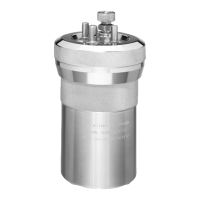
The 1138 Oxygen Combustion Vessel is made from
alloy 20; a special niobium stabilized stainless steel se-
lected for its resistance to the mixed nitric and sulfuric
acids produced during the combustion process. The
1138CL is made from the halogen resistant Hastelloy
G30™. Hastelloy 30™ is an alloy rich in cobalt and
molybdenum and is able to resist the corrosive effects
of free chlorine and halogen acids produced when
burning samples with significant chlorine content.
While no alloy will completely resist the corrosive
atmospheres produced when burning samples con-
taining halogen compounds; users who intend to test
these materials are urged to select the 1138CL Oxygen
Combustion Vessel. These vessels are 250 mL in
volume and are rated to a maximum working pressure
of 137bar (2000psi). The vessels are hydrostatically
tested to 207bar (3000 psi) and the optimal sample
range is ~1g or 21kJ to 33 kJ (5kcal to 8 kcal).
Explosives and High Energy Fuels
CAUTION! Materials which release
large volumes of gas which detonate with
explosive force or burn with unusually
high energy levels, should not be tested
in this calorimeter. Rather, they should be
tested in a model 6100 or 6200 Calorim-
eter which can be equipped with an 1104
High Strength Oxygen Combustion Vessel
designed specifically for these types of
samples.
Volatile Sample Holders
Volatile samples are defined as one with an initial
boiling point below 180 ºC. Volatile samples can
be handled in a 43AS Stainless Steel Capsule
which has a sturdy wall with a flat top rim. These
holders can be sealed with a disc of plastic adhesive
tape prepared by stretching tape across the top of



 To Next Page