630D
'----
-
---
PL::
TIG
B
J..-------,V"
..
""ON
•
SIGNAL
(TP71__
rL..
____________
- - -
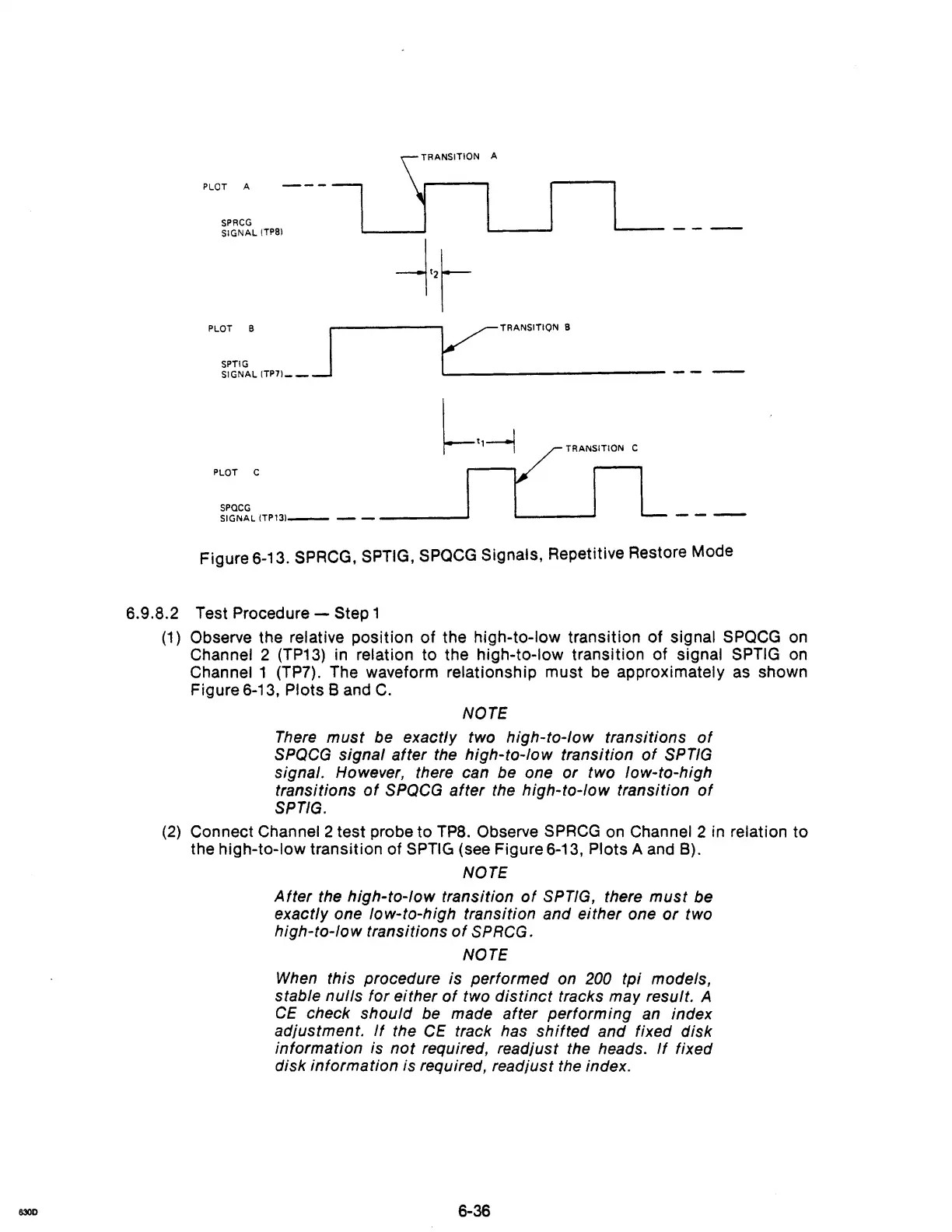
Figure 6-13. SPRCG, SPTIG,
SPOCG
Signals, Repetitive Restore Mode
6.9.B.2 Test Procedure - Step 1
(1)
Observe the relative position of the high-to-Iow transition of signal
SPOCG
on
Channel 2
(TP13)
in relation to the high-to-Iow transition of signal
SPTIG
on
Channel 1 (TP7). The waveform relationship must
be
approximately
as
shown
Figure 6-13,
Plots
Band
C.
NOTE
There
must
be exactly two
high-to-Iow
transitions
of
SPQCG
signal
after
the
high-to-Iow
transition
of
SPTlG
signal. However, there can be one
or
two
low-to-high
transitions
of
SPQCG
after
the
high-to-Iow
transition
of
SPTlG.
(2)
Connect Channel 2 test probe
to
TPB.
Observe
SPRCG
on Channel 2
in
relation to
the
high-to-Iow transition of SPTIG (see Figure 6-13, Plots A and B).
NOTE
After
the
high-to-Iow
transition
of
SPTlG, there
must
be
exactly one
low-to-high
transition
and
either
one
or
two
high-to-Iow
transitions
of
SPRCG.
NOTE
When this procedure is performed on 200
tpi
models,
stable
nulls
for
either
of
two
distinct
tracks may result. A
CE
check
should
be made
after
performing
an index
adjustment.
If
the CE track has
shifted
and
fixed
disk
information
is
not
required, readjust the heads.
If
fixed
disk
information
is required, readjust the index.
6-36



 To Next Page