46-3
Servicing Conveyors
EN
2. Before starting the conveyor, it is essential to
check the following.
3. The conveyor is straight and correctly levelled.
4. The head and tail drums are correctly tted. i.e.
They are level, and that their axes are square to
the centre line of the conveyor.
5. All trough type and parallel idlers are correctly
tted with their axles square to the centre line
of the conveyor, the side roller lead is in the
correct direction [i.e. forward of centre] and all
rollers are rotating freely.
6. In the case of screw-type take up gears, that
these are adjusted initially to take up slack from
the belt and that equal tension is applied to
each side such that the pulley is square to the
centre line of the conveyor.
7. Where skirt rubbers are tted they are not
bearing down heavily on the belt.
8. There is no obstruction on the conveyor that
could cause accident or damage when the
conveyor is started.
9. Tracking should be carried out with the belt
empty. With very sti belts, which do not trough
well nor make proper contact with the centre
idlers roller when empty, it may only be possible
to track the return strand when empty and the
troughed side when loaded.
10. If the belt tends to run to one side the most
likely cause of the trouble will usually be some
distance before the point where the running o
is apparent, and in the case of troughed strand
probably at the second or third idler behind the
point where the belt is moving out of its true
line.
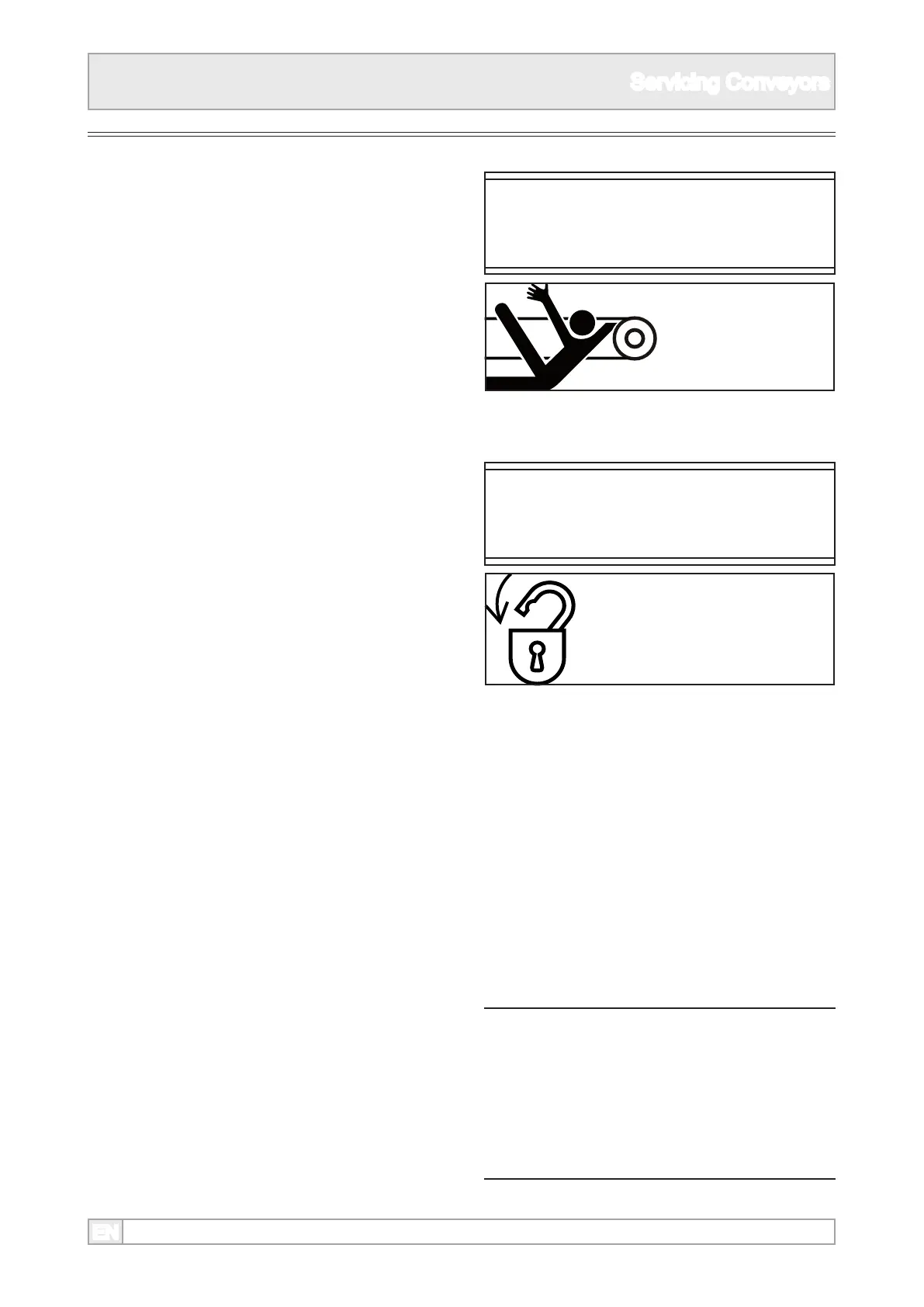
ENTANGLEMENT
HAZARD
n DANGER
Refer to Safety Notices Section for relevant
warning and procedure
n WARNING
Refer to Safety Notices Section for relevant
warning and procedure
LOCKOUT
MACHINE
n DANGER
Under no circumstances should any
adjustment be made on the belt whilst
the machine is running. There is an
entanglement hazard and risk of trapping
parts of the body.
Training of Belts



 To Next Page