Page 77 of 86 SCHÄFER IT-Systems
Industriestraße 41 D-57518 Betzdorf
Phone: +49 (0) 2741/283-770 sales@schaefer-it-systems.de www.schaefer-it-systems.de As
amended on 16/8/2019 (subject to technical changes)
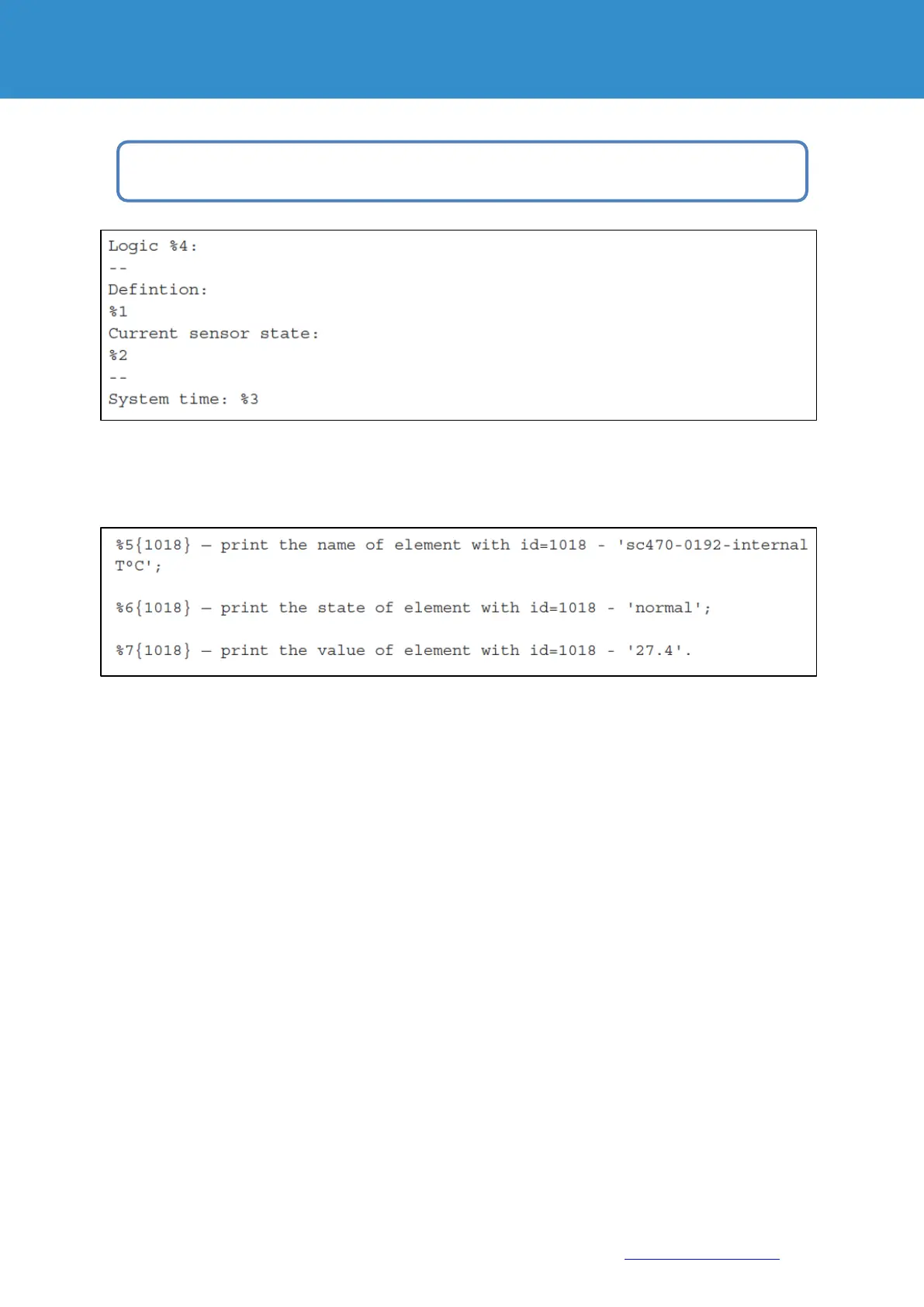
The macros %5, %6, % 7 are able to parameterise using the element designation {id}, i.e. the element for which the
evaluation is to be made can be specified for these macros.
Example for the evaluation of macros:
If an element with the specified name is not found in the text of the message, it is inserted -'id = xxxx not found '.
If the {id} parameter is not specified, a calculated value for the element that is triggered by the logic diagram is
inserted in the text of the message.
Macro % 8 has been available since version 2.4.4. The % 8 macro is used to determine the identifier of the sensor
when the logic diagram is triggered.
The identifier is shown in single quotation marks in the body of the message (example: '302014').
The % 8 macro can be used to determine the identifier of the sensor when the logic diagram is triggered by a
change in the state of the group.
Suppose there is a logic diagram that links the group state change to sending the notification.
At the beginning, all elements in the group are in a normal state. The group is also in the normal state. The logic is
inactive.
Next, one of the sensors in the group is triggered. Accordingly, the group also goes into the alarm state. The logic
circuit is activated according to the operating status of the group. The logic circuit is activated according to the
operating status of the group. The text is created according to the template and the notification is sent.
In this case, %5, %6 will be replaced with the name and status of the group when the notification text macros are
created. The macro %8 is replaced by the value of the identifier of the triggered sensor within the triggered group.
This means that if the state of the element has changed, the group, module or system in which this element is
incorporated also changes the state if the state of the element changes and the state change of the group triggers
the logic.
We recommend using a more informative form of the message. By default it is written in the following
form:



 To Next Page