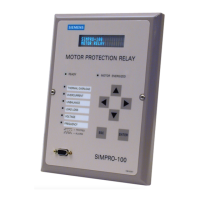
SIMPRO-100
Control Equations & Relay Logic
B
PRIM-2400C 139
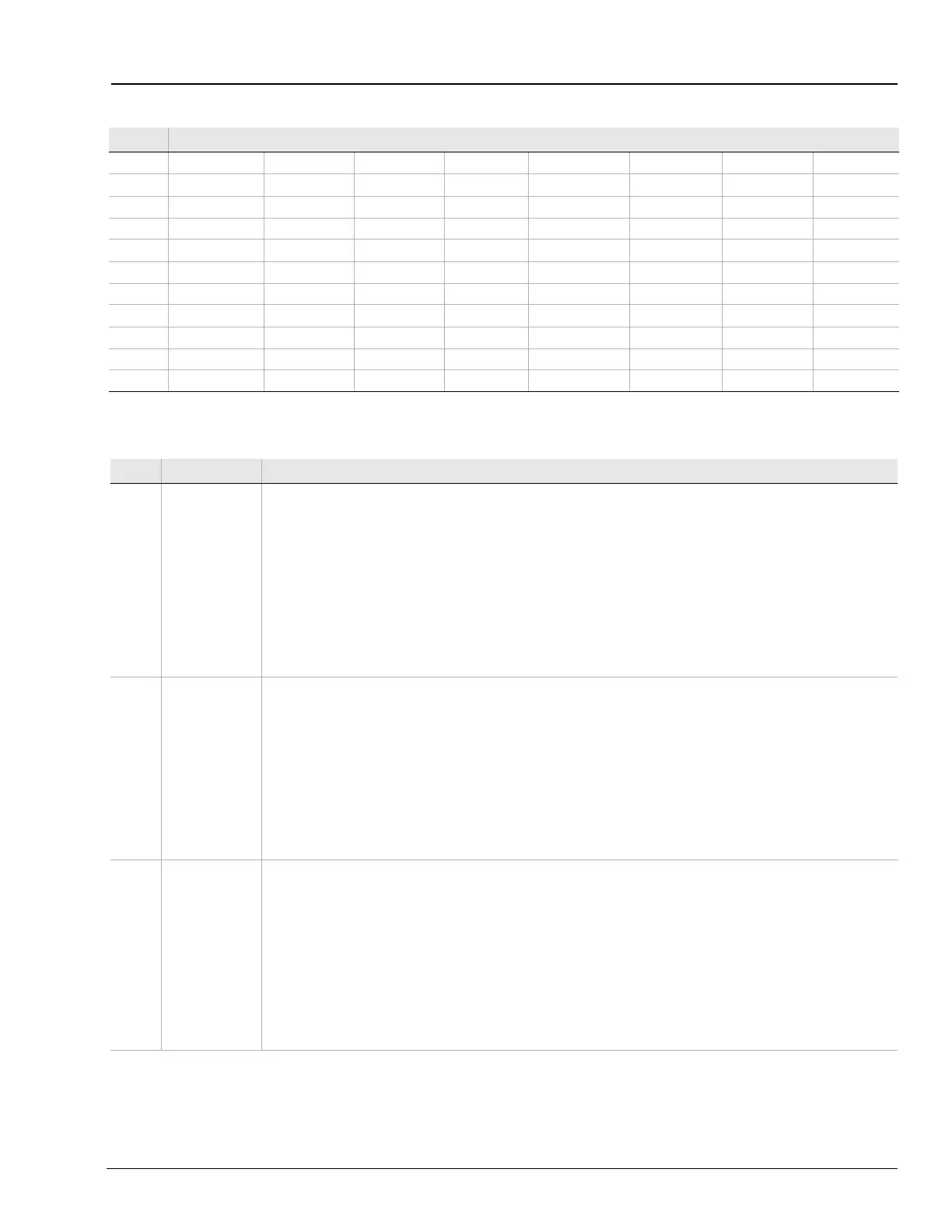
Table B.1 SIMPRO-100 Relay Word Bits
Row Relay Word Bits
1 STARTING RUNNING STOPPED JAMTRIP LOSSALRM LOSSTRIP 46UBA 46UBT
2 49A 49T THERMLO NOSLO TBSLO ABSLO * *
3 50P1T 50P2T 50N1T 50N2T 50QT 50S 50G1T 50G2T
4 47T TRGTR START 52A SPDSTR SPEEDSW RTDBIAS RTDFLT
5 WDGALRM WDGTRIP BRGALRM BRGTRIP AMBALRM AMBTRIP OTHALRM OTHTRIP
6 27P1 27P2 59P1 59P2 59G 81D1T 81D2T 81D3T
7 37PA 37PT 55A 55T VARA VART * *
8 LT1 LT2 LT3 LT4 RB1 RB2 RB3 RB4
9 SV1 SV2 SV3 SV4 SV1T SV2T SV3T SV4T
10 IN1 IN2 IN3 IN4 IN5 IN6 IN7 *
11 TRIP OUT1 OUT2 OUT3 ALARM * * *
Row Bit Definition
1
STARTING Asserts when protected motor is starting (current is greater than 2.5 times motor rated full load current).
RUNNING Asserts when motor is running.
STOPPED Asserts when motor is stopped (current is less than 3% of motor rated full load current).
JAMTRIP Load-Jam Trip.
LOSSALRM
LOSSTRIP
Load-Loss Alarm and Load-Loss Trip. Assert when the relay detects a load-loss as defined by that
function and its settings. These Relay Word bits are inactive if the function is disabled by relay settings.
46UBA
46UBT
Phase Current Unbalance Alarm (46UBA) and Trip (46UBT). Assert when the relay issues an alarm or
trip in response to a current unbalance condition, as defined by that function and its settings.
2
49A
49T
Thermal Alarm (49A) and Trip (49T). Assert when the relay issues a thermal element alarm or trip due
to locked rotor starting or running overload conditions.
THERMLO
NOSLO
TBSLO
ABSLO
Motor Lockout Conditions. Asserted by the thermal element (THERMLO), starts per hour function
(NOSLO), minimum time between starts (TBSLO), and the antibackspin timer (ABSLO).
*
*
Reserved for future use.
3
50P1T
50P2T
Level 1 and Level 2 Definite-Time Phase Overcurrent Elements.
50N1T
50N2T
Level 1 and Level 2 Definite-Time Neutral Overcurrent Elements.
50QT Negative-Sequence Overcurrent Element.
50S Motor Starting Overcurrent Element (pickup = 2.5 • full load current).
50G1T
50G2T
Level 1 and Level 2 Definite-Time Residual Overcurrent Elements.



 To Next Page