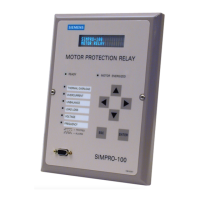
SIMPRO-100
Metering & Monitoring
8
PRIM-2400C 115
• Hottest winding RTD temperature
• Hottest bearing RTD temperature
• Ambient RTD temperature
• Hottest other RTD temperature
8.4.3 Learned Parameters
The SIMPRO-100 Relay can learn two protection
parameters of the protected motor. When you
connect the relay to monitor at least one motor
winding RTD and the ambient temperature, the
relay can learn the cooling time of the protected
motor when it is stopped. The relay can also learn
the thermal element thermal capacity used when
the motor starts. The motor statistics report
includes both of these learned parameters.
8.4.4 Alarm and Trip Counters
The relay records the number and type of
element alarms and trips that occur for the
protected motor. The reported trip counter types
are listed below. If the relay does not include
optional voltage or RTD inputs, the motor
statistics report does not include counter types for
those elements. Those items marked with an (
*
)
also have alarm counters:
• Thermal Element
*
• Locked Rotor
*
• Load Loss
*
• Load Jam
• Unbalance Current
*
• Phase Fault
• Ground Fault
• Speed Switch
• Undervoltage
• Overvoltage
• Underpower
*
• Power Factor
*
• Reactive Power
*
• Phase Reversal
• Underfrequency
• Overfrequency
•RTD
*
• Total
*
8.5 Motor Start Report
Each time the relay detects a motor start, it stores
a motor start report. The five latest motor start
reports are stored in nonvolatile memory. View
any of the five latest motor start reports using the
serial port MSR n command, where n = 1 – 5.
Each report consists of two parts: a summary and
the start data.
8.5.1 Summary Data
Each motor start report contains a summary. The
summary shows the following information:
• Date and time of the start
• Number of motor starts since last reset
• Motor acceleration time
• Starting % Thermal Capacity
• Maximum Starting Current
• Minimum Starting Voltage, if voltages are
present
The motor acceleration time is calculated from
the time the phase current magnitude exceeds
2.5 times Full Load Amps until the current
magnitude falls below that level. The Starting %
Thermal Capacity value is the thermal element
capacity used at the end of the start, expressed in
percent of the trip value.



 To Next Page