INTRODUCTION
compensate for this fact, most safety agencies require that the equivalent DC test be
performed at a higher voltage than the AC test. The multiplying factor is somewhat
inconsistent between agencies, which can cause confusion.
The Insulation Resistance Test....
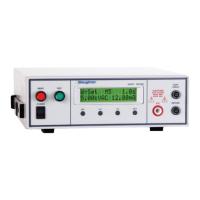
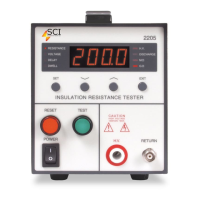
Some dielectric analyzers today come with a built-in insulation resistance tester.
Typically, the IR function provides test voltages from 500 to 1,000 volts DC and
measures resistance from kilohms to gigohms. BABT, TÜV, and VDE are agencies that
may, under certain conditions, require an IR test on the product before a Hipot test is
performed. IR testing typically is not done on the production line, but as a performance
design test.
The IR test is very similar to the Hipot test. Instead of the go/no go indication that you
get with a Hipot test, the IR test indicates an insulation value, usually in Megohms.
Typically the higher the IR value, the better the condition of the insulation. The
measured value represents the equivalent resistance of all the insulation between the two
test points, and any component resistance which might also be connected between the
two points. The connections to perform the IR test are the same as the Hipot test.
Although the IR test can predict insulation condition, it does not replace the need to
perform a Dielectric Withstand test.
TYPES OF FAILURES DETECTABLE ONLY WITH A HIPOT TEST
Weak Insulating Materials
Pinholes in Insulation
Inadequate Spacing of Components
Pinched Insulation
Why Perform a Ground Bond Test….
Ground Bond testing is done to ensure that a low resistance path exists between the safety
ground pin of a three-wire line cord and exposed metal of the device under test. Ideally,
if a live wire inside the item under test became loose and contacted the chassis, the fault
current would flow through the low resistance safety ground, and protect the user.
The need for high current bonding (i.e. 30A or 60A) as apposed to low current go-no go
type testers, is the result of the line voltage breakers’ high current characteristics. Safety
grounding circuits must withstand the line voltage breaker’s current rating in order to
maintain safe voltage potentials on the chassis of the faulty device. Verifying the
integrity of the grounding circuit at high currents ensures that the line breaker will open
before the grounding circuit wires fail.
The Line Leakage Test….
The Line Leakage test measures the amount of leakage current that is produced while a
product is running. The test is unique in that it is performed while the DUT is running,
thus an external power supply is required to perform the test properly. Usually the user
needs to supply the voltage source to power the DUT.


 To Next Page