17. CHECK AND ADJUSTMENT
17-7
17.3.4 Collimation of the Instrument
Collimation is required to make the line of sight of the telescope perpendicular to the horizontal axis
of the instrument, as otherwise, it will not be possible to extend a straight line by direct means.
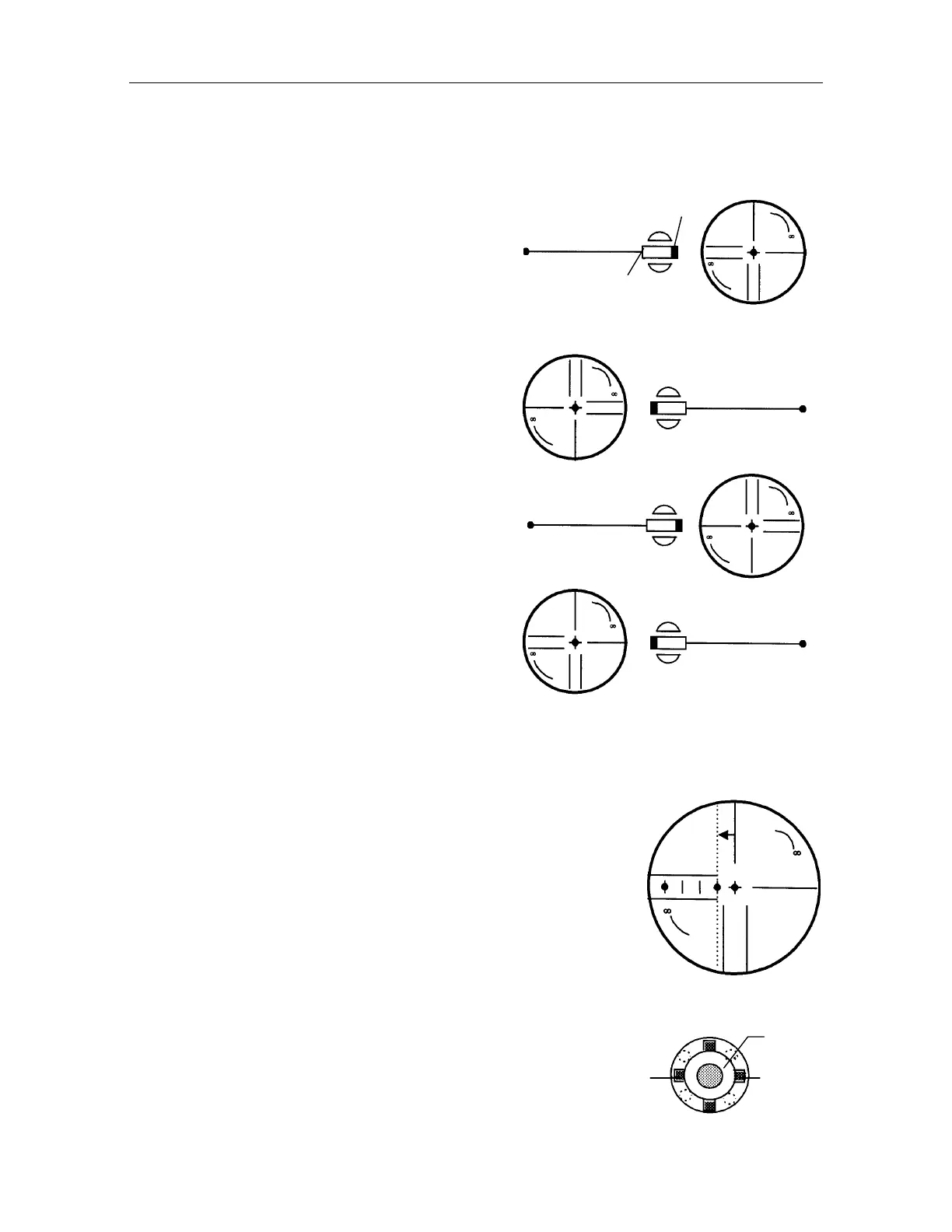
Check
Set the instrument up with clear sights of about
50 to 60meters (160 to 200 ft.) on both sides of
the instrument.
Level the instrument properly with the plate
level.
Sight Point A at approximately 50 meters (160
t.) distance.
Use the vertical jog and shuttle only and rotate
the telescope 180 or 200g around the
horizontal axis, so that the telescope is pointed
in the opposite direction.
Sight Point B, at equal distance as Point A.
Use the horizontal jog and shuttle ,and rotate
the instrument 180 or 200g around the vertical
axis. Fix a sight on Point A once more.
Use the vertical jog and shuttle only and rotate
the telescope 180 or 200g around the
horizontal axis once more and fix a sight on
Point C, which should coincide with previous
Point B.
If Points B and C do not coincide, adjust in the
following manner.
Adjustment
Unscrew the cross-hair adjustment section cover.
Find Point D at a point between Points C and B, which
should be equal to 1/4th the distance between Points B and
C and measured from Point C. This is because the apparent
error between Points B and C is four times the actual error
since the telescope has been reversed twice during the
checking operation.
Shift the vertical cross-hair line and coincide it with Point D,
by revolving the left and right capstan adjustment screws
with the adjusting pin.Upon completing the adjustment,
repeat the checking operation once more. If Points B and C
coincide, further adjustment is not required. Otherwise ,
repeat the adjustment .
Eyepiece
A
A
C
50m
Telescope
B
50m
50m
50m
C
D
B
Eyepiece
Capstan
adjustment
screws
Capstan
adjustment
screws



 To Next Page