SonTek – a Xylem brand
FlowTracker2 User’s Manual (January 2019) 224
Principle of Operations Section 13.
13.1. FlowTracker2 Overview
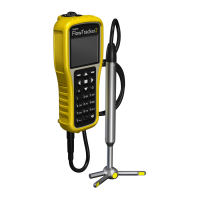
The FlowTracker2 Handheld ADV is a single-point Doppler current meter designed for
field velocity measurements. The FlowTracker2 uses the proven Doppler technology of
the SonTek Acoustic Doppler Velocimeter (ADV), the leading high-resolution velocity
sensor. ADV technology provides several advantages.
• Accurate velocity measurements in a remote sampling volume,
• 2D or 3D velocity measurements (depending on probe configuration),
• Invariant factory calibration, no periodic recalibration required,
• Rapid response time,
• Simple operation,
• Excellent performance for low and high flows – accuracy 1% of measured
velocity,
• Built-in temperature sensor.
The FlowTracker2 offers ADV performance from a simple handheld interface, allowing
rapid data collection without the use of a computer. Some common applications
include:
• River discharge measurements (using established methodology, including
USGS/ISO),
• Open-channel flow measurements,
• Current measurements in large pipes,
• Rapid, multi-point current surveys,
• Current monitoring in water treatment facilities.
13.2. The Doppler Shift
The FlowTracker2 uses a highly sophisticated form of this technique, which processes
underwater sound (sonar) reflected from particulate matter suspended in the water.
a) The Doppler principle says that if a source of sound is moving relative to the
receiver, the frequency of the sound at the receiver is shifted from the transmit
frequency.
=
×
where, F
doppler
= change in received frequency (Doppler shift),
F
source
= frequency of transmitted sound,
V = velocity of source relative to receiver,
C = speed of sound.


 To Next Page