OPERATION
Carl Zeiss Illumination and contrast methods Axio Imager
172 430000-7344-001 M70-2-0020 e 06/2009
• Place the specimen on the stage, focus on it
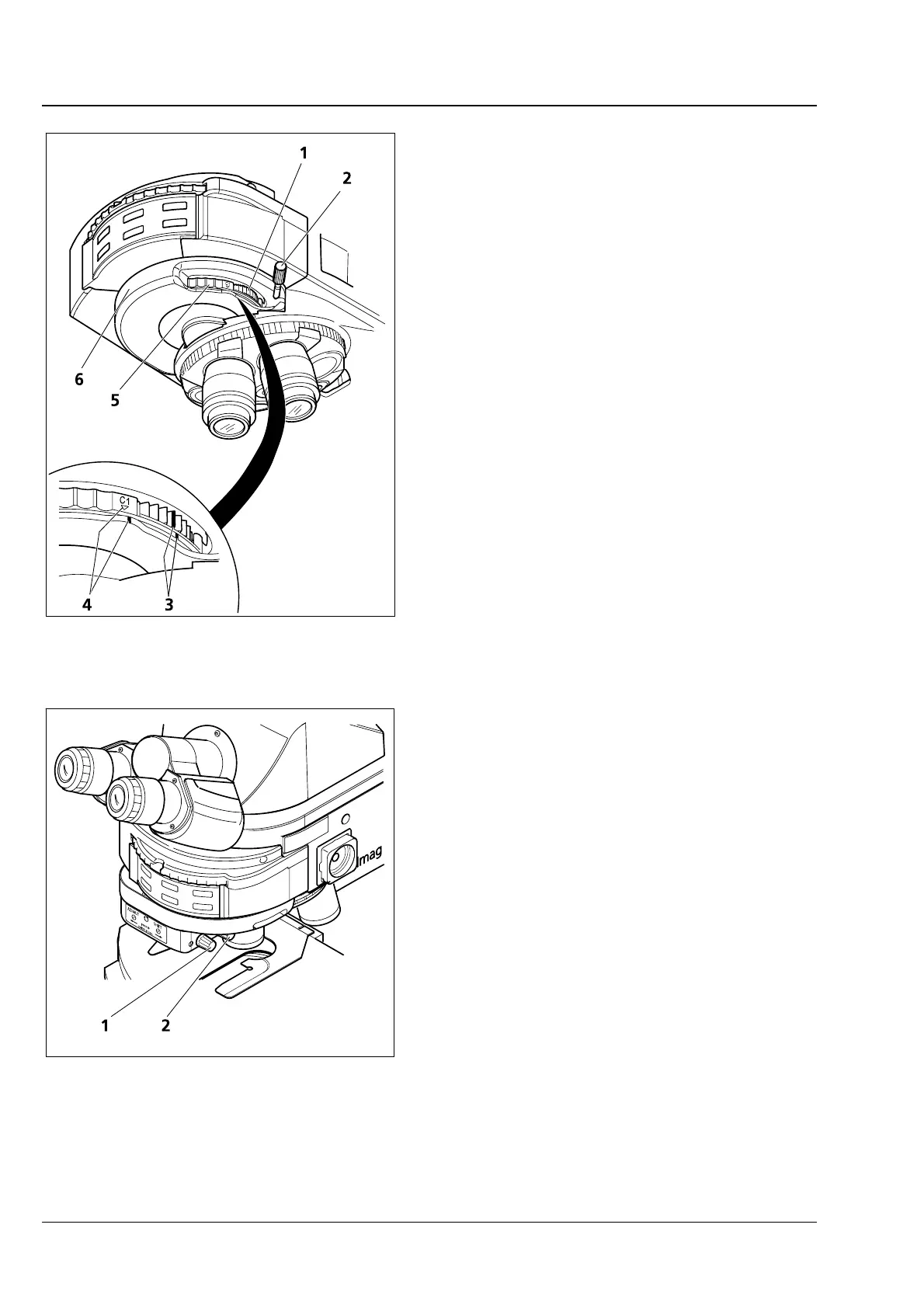
and rotate the control wheel (
4-1291) on the
C-DIC slider 6x20 or the modulator turret
(
4-130/1) until the specimen detail of interest is
visible at maximum contrast. Rotating the stage
is no longer necessary. If both line marks are
facing each other (
4-130/3), this corresponds to
the mid-position. Rotation by 45° in both
directions is possible).
• The contrast can be optimized by turning
setscrew (
4-129/2) on the C-DIC slider or on the
modulator turret (
4-130/2). If triangular and line
mark are facing each other (
4-130/3), this
corresponds approximately to the extinction
position (best contrast).
(5) Motorized four-position modulator
turret for circular DIC/TIC
• Set the microscope up for reflected-light
brightfield.
• Put reflector module C DIC P&C in the light
path.
• On the nosepiece, swivel in the objective
suitable for DIC.
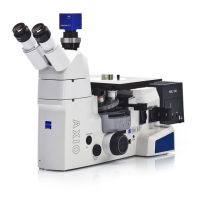
• On the modulator turret, swivel in the
appropriate DIC prism by pressing on knob
• (4-131/1) for forward rotation or on knob
(
4-131/2) for backward rotation of the turret.
• Put on the specimen, focus and turn knob
(
4-131/2) (SHIFT) in such a way that the
structure of interest can be seen in maximum
contrast.
• Contrast can be optimized by turning knob
(
4-131/1) (AZIMUT) on the modulator turret.
Fig. 4-130 4-position modulator turret
Fig. 4-131 Motorized four-position modulator
turret for circular DIC/TIC



 To Next Page