REMOTE OPERATION STATUS COMMANDS
4-198
Status reporting
An instrument within a SCPI-based system contains a set of registers that reflect the current state
of the instrument and whether a particular event has occurred. It is also sometimes necessary for
an instrument to generate an alert if that condition exists or if that event has occurred.
The status registers contain information about the condition of the instrument. Using these
registers, it is possible to find out, for example, whether an error has occurred with a command, if
the local oscillator has locked, or if the external frequency standard is present. These registers can
be used either by reading the contents directly when needed, or by configuring them to generate an
interrupt signal (SRQ, service request) when the condition of interest occurs. The status system
consists of readable (‘questionable’) registers, together with status, standard event and operation
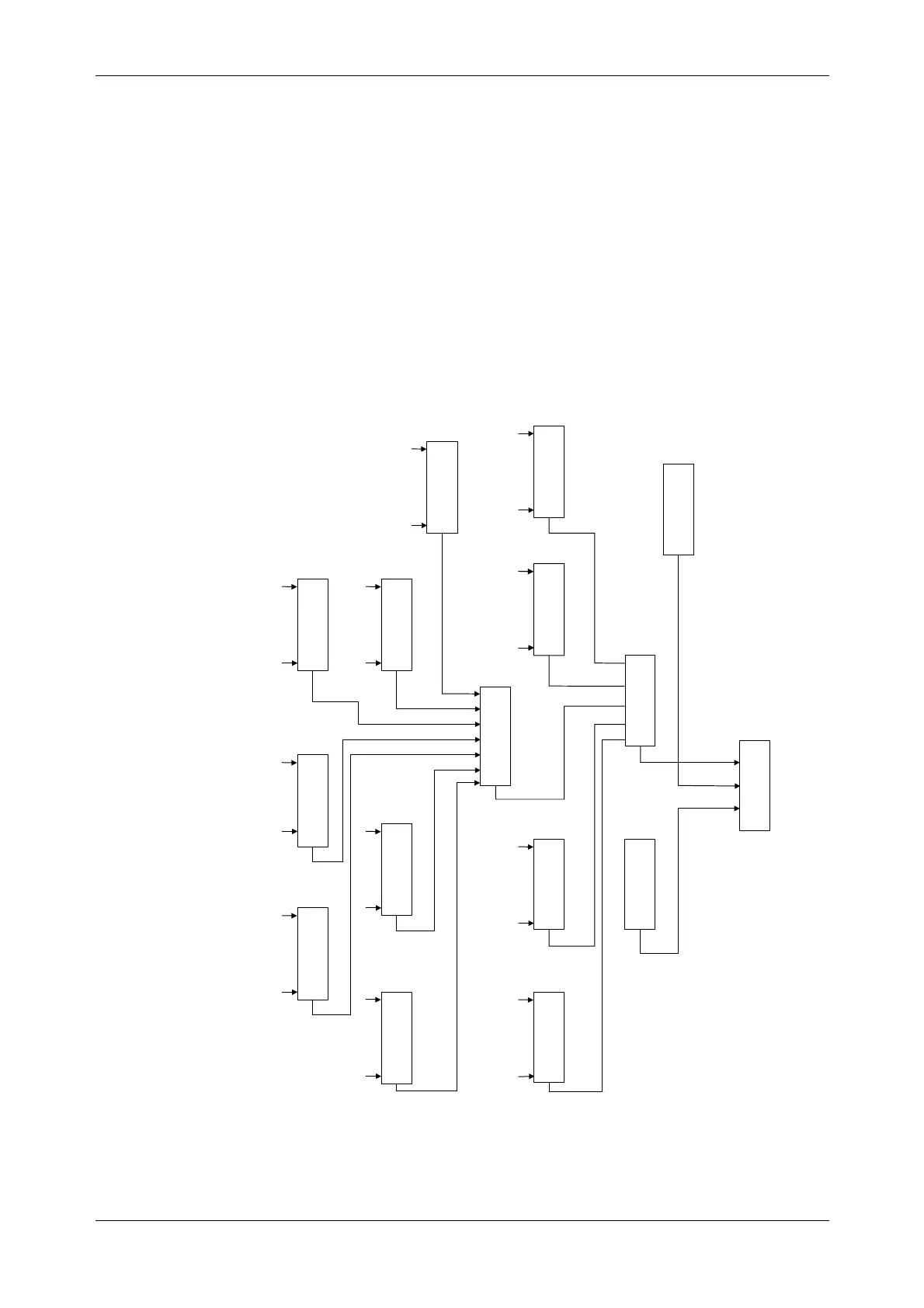
registers, as shown in Fig. 4-4. These registers are described below, and in greater detail on
pages 4-203 onwards. Logic level ‘1’ represents a set bit.
Status byte
Bit 3
Bit 5
Bit 7
Operation
status
Questionable
status
Standard event
Bit 5
Bit 7
Bit 3
Bit 8
Questionable
power
Questionable
frequency
Questionable
modulation
Questionable
calibration
Power, frequency,
calibration & modulation
registers
Bits 0–4 Used
Bits 5–15 Unused
Questionable
ROSCillator
Questionable
modulation DM
Questionable
modulation IQ
Questionable
modulation PULM
Questionable
modulation ARB
Questionable
modulation AM
Questionable
modulation FM
Bit 3
Bit 4
Bit 2
Bit 1
Bit 0
Questionable
modulation PM
Bit 9
Bit 6
Bit 5
Fig. 4-4 Simplified status register structure


 To Next Page