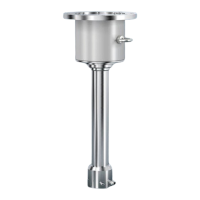
less measurement, the count rates measured by the Tritium
probe are typically about 20% higher than indicated on the con-
trol substance (contrary to the Xenon probe LB 1231 which is
sealed by a 5 mg Titan window foil).
Test measurements with
3
H substances, however, may also
cause problems, because even minor distance changes, con-
tamination of the source or decay of Tritium in the course of
time will result in changes in the count rate which are not due to
the instrument itself. The Tritium half-life of 12.26 years must
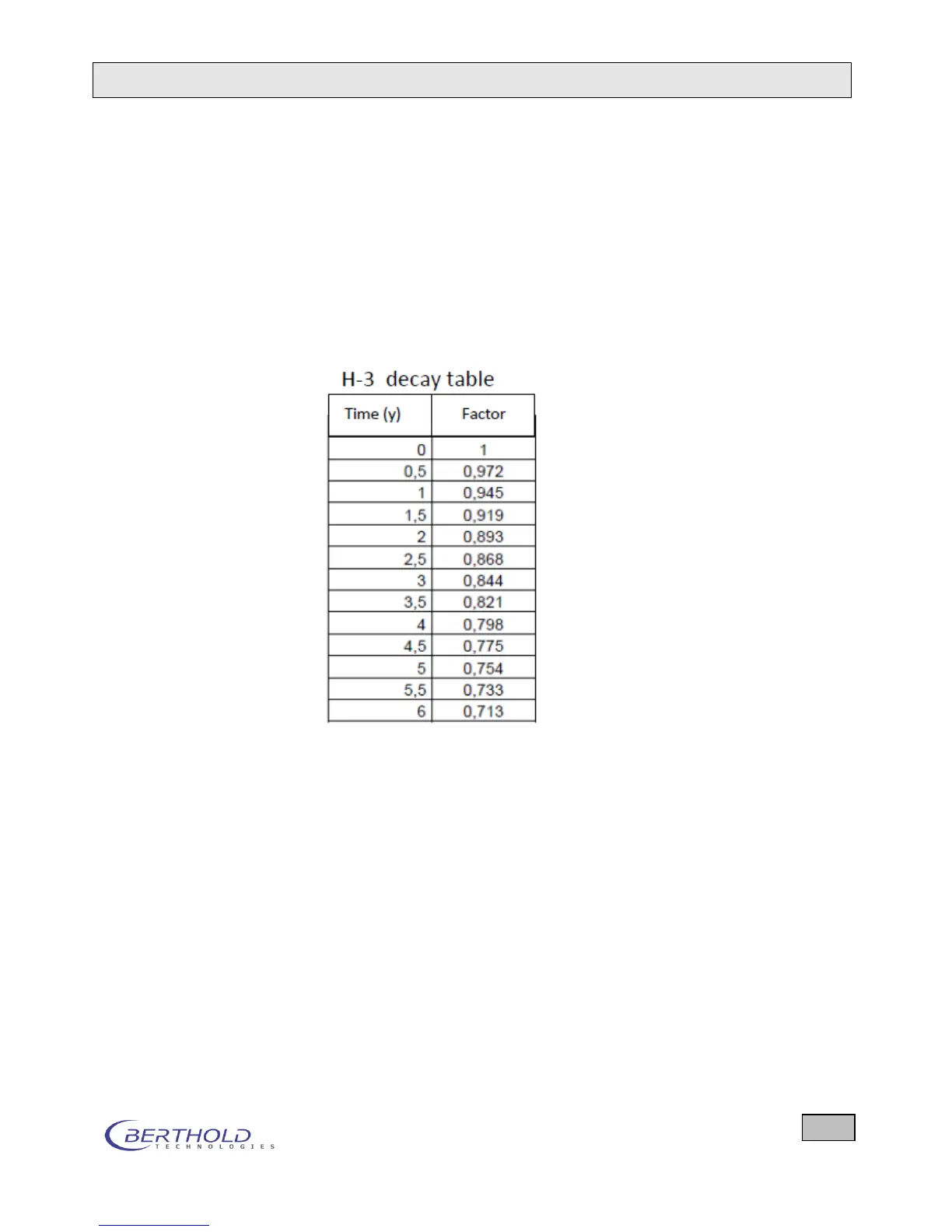
also be taken into account (see the table below).
Upon request, the
3
H calibration source TRR 16161 (~ 10 kBq)
can be supplied as control substance. The number of Beta par-
ticles emitted into the half-space as well as the reference data
is marked on the plate. In the case of
3
H, one will measure
about 85% of the emitted particles.
7.9.9 Efficiency and Detection Limits
Detecting
3
H Contamination
There is no completely satisfactory method for detecting
3
H
contamination. The following options are available:
Direct measurement using the Monitor LB 134/LB 1239




 To Next Page