a) whether the same radionuclide has been set, and
b) whether the source used for calibration meets the above
mentioned requirements.
When measuring area contaminations, the extent of the con-
tamination relative to the standardized area of the calibration
source of 100 cm² (in the setting A-100) also plays a role.
For measurements according to §44 of the Radiation Protection
Ordinance (Germany), the averaging area can be up to
300 cm². The measurement area of the probe LB 1342 is 118
mm x 145 mm (171 cm²) at a transmission of 80%. In the
LB 1343 probe the active measurement area is 345 cm².
For contaminations less than 100 cm² this averaging is done
automatically due to the aforementioned calibration conditions.
A contamination of, say, 10 Bq/cm², but an expansion of only 50
cm², is displayed as 5 Bq/cm² (distributed over 100 cm²) as a
result of this averaging.
However, if the extent of the contamination is greater than 100
cm², the monitor overevaluates: It shows at 10 Bq/cm², spread
over 150 cm², for example, 15 Bq/cm².
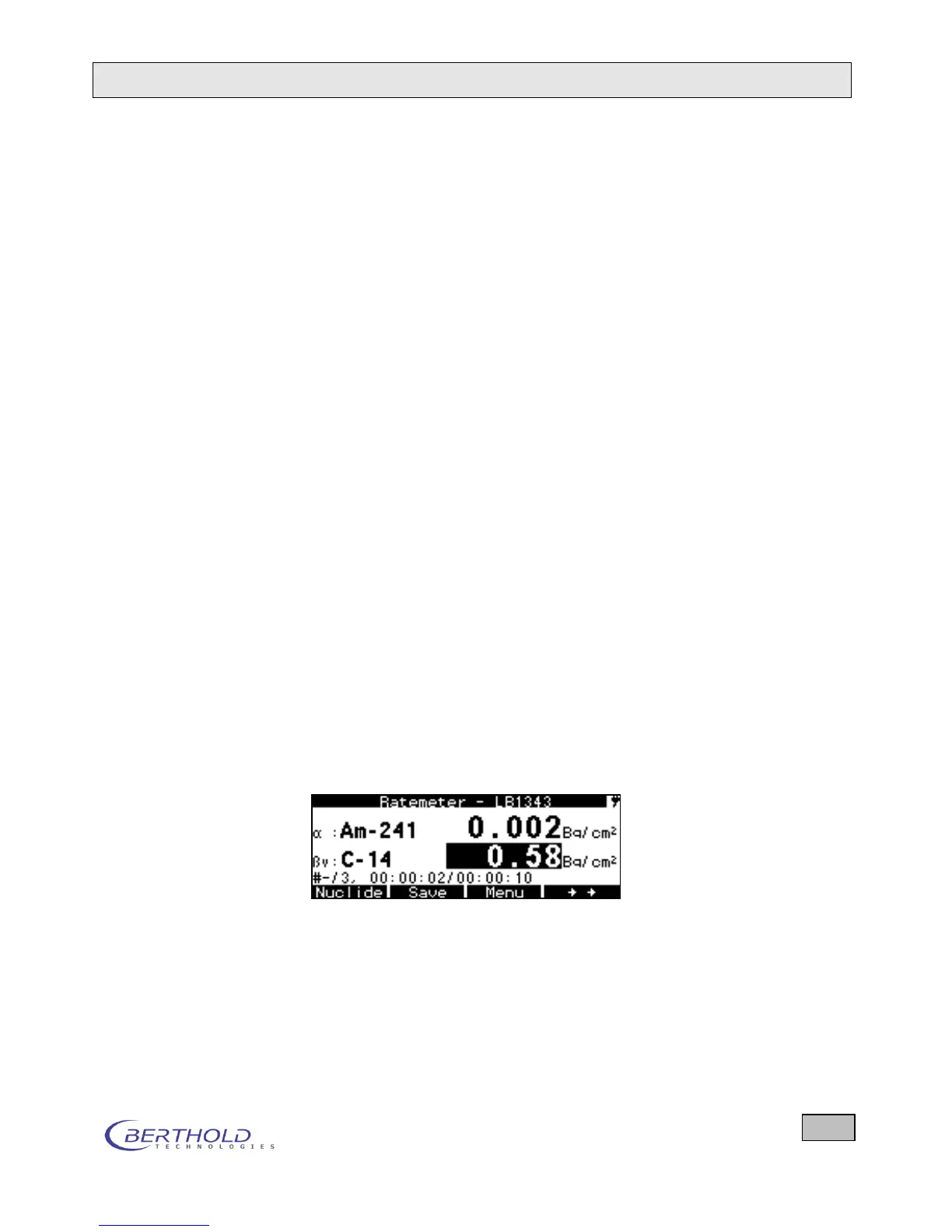
5.4 Exceeding of Limit Values
Any exceeding of user-defined limit values is indicated on the
display by a flashing measured value ( or ). Moreover, an
alarm signal is output (visual as flashing LED, audible as short
alarm beep), if preset (see System menu: Parameter->Alarm).
The alarm is displayed in any case, no matter which measure-
ment mode you are in.
Figure 4.17: Exceeding of limit values
If the entrance window is defective (light enters the counting
chamber) and the count rate is exceeded for a short time, the
scintillation detector is turned off, i.e. the high voltage is turned
off. In this case, the entrance window must be replaced.




 To Next Page