5. Contamination Measurements
In this chapter we will discuss the contamination measurement,
which is representative of the performance of other measure-
ments. Other measurements, for example, activity measure-
ments of samples or dose rate measurements, are very similar,
but they still differ in some respects. Contamination and activity
measurements usually deal with specific nuclides or nuclide
mixes, whereas we usually do not know the nuclides in a dose
rate measurement. Selectable measurement types were there-
fore introduced instead of nuclides to quickly switch between
different units (e.g. µSv/h and mrem/h). In all cases, you can
use the ratemeter function or the counter timer function, de-
pending on accuracy considerations. Sample measurements,
however, should essentially be performed using the counter
timer function. You can also calculate the integral over the
measurement unit in all types of measurement, which is of ma-
jor importance in dose rate measurements for the calculation of
the dose. In contamination measurements, one can determine
the counts for a given period from the cps values through inte-
gration by selecting Net.
We will now take a closer look at a contamination meas-
urement.
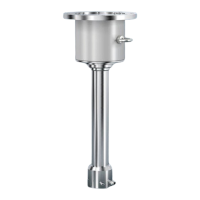
Contamination measurements can be performed immediately
after starting up the device and in conjunction with an external
contamination probe. After power on, the device starts a meas-
urement immediately and displays the results for the preset nu-
clide and measurement mode or for the background measure-
ment (if the autostart function has been enabled).
Please note that the following three operations have to be per-
formed as a prerequisite for adequate contamination measure-
ments:
1. After commissioning of the monitor and later at regular inter-
vals, you have to perform a functional check and verify the
correct operation of the device. This is also required by § 67
of the Radiation Protection Ordinance (in Germany).
2. Usually, we first measure the ambient radiation caused by
the activities (= background) to obtain the pure surface radi-
ation. The stored background is subtracted automatically
from all measurements.
3. Nuclide-specific alarm thresholds are entered for the radia-
tion to be measured; audible and visual alarms are triggered
when these thresholds are exceeded.




 To Next Page