For further details see the DIN standard 25415 T2 "Decontami-
nation of Radioactively Contaminated Surfaces; Determination
of Surface Contamination".
Calibration Factor and Detection Limits of the Tritium
Probe LB 1239
When the probe LB 1239 is correctly positioned over a flat sur-
face, about 85% of the Beta particles emitted from the surface
below the window opening will be detected and counted, be-
cause the electrons created outside the actual counting room
are "pulled" into the detector. For a
3
H-source that is free of
self-absorption we will therefore get the following calibration
factors:
Point source 2.2 Bq (6 x 10E-5 μCi) per cps
Area source 0.1 Bq/cm² (2.7 x 10E-6 μCi/cm²) per cps
(with window completely open)
1 Bq/cm² (2.7 x 10E-5 μCi/cm²) per cps
with aperture plate exceeding the size of the
window opening
With a background of approx. 1 s
-1
this results in the following
detection limits for
3
H substances at a statistical safety of 3σ:
Ratemeter time constant *)
τ = 200s
point source activity approx. 0.33 Bq
(free of self-absorption) approx. 0.01 nCi
area-specific activity approx. 0.015 Bq/cm²
approx. 0.04 10E-5μCi/cm²
*) With the LB 134 the time constant in the normal measurement mode
is 120 s. The Counter/Timer mode can be used for more accurate
measurements.
The limit threshold for 5 Bq/cm
2
(according to the German Ra-
diological Protection Act, Appendix IX) is 55 cps
-1
with fully
open window or 5 cps with aperture plate.
7.9.10 Working with the β-γ-Probe
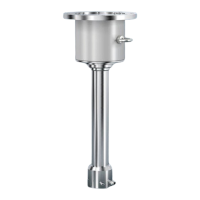
On the left side of the trolley console there is the compartment
for the β-γ-probe LB 1231. Its connection cable to the LB 134
can be hooked into the circular holding device. Proceed as fol-
lows if you want to use this probe instead of the Tritium probe:




 To Next Page