WARNING!
Risk of Faulty Treatment
If the patient is admitted to a hospital or is prescribed any other form of medical treat-
ment, always inform the medical staff that the patient is on mechanical ventilation
treatment.
Risk of Faulty Treatment
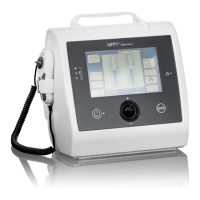
Do not use the Nippy 4 in the event of:
• Suspected damage to the device, including the occurrence of Internal Functional
Failure alarms.
• Unexpected patient symptoms during treatment.
• Unexplainable or sudden changes of pressure, performance or sound during
operation.
• Delivered air being abnormally hot or emitting an odor.
Contact your responsible care provider for an inspection.
Risk of Faulty Treatment
The responsible organization should periodically reassess the settings of the therapy for
effectiveness.
Before starting treatment, always perform the procedure 4.5 Inspecting the Nippy 4 before
Use , page 39.
The ventilator is not suitable for a ventilator dependent patient.
Risk of Unnoticed Critical Conditions
• The alarm sound level should be set to a clearly audible level. Setting the alarm
sound level below that of the ambient sound level can impede recognition of alarm
conditions.
CAUTION!
Clinical personnel must read the Clinician’s manual thoroughly and understand the venti-
lator operation before setting up and using the ventilator.
• Handle the ventilator with care.
• Do not use the ventilator while in the carry bag.
• Do not use the ventilator with nitric oxide, helium or helium mixtures.
Contact Injuries: Skin irritation may occur due to prolonged exposure to either a mask (if
used) or the SpO
2
module.
Ensure that the cooling air intake vents are not blocked. If the vents are blocked, espe-
cially in hot use environments, the surface temperature of the patient circuit may rise
above 41°C (106°F). In a 40°C (104°F) environment and with the cooling air intake vents
blocked, surface temperatures as high as 50°C (122°F) can occur. Before an unsafe tem-
perature is reached, the “High Patient Air Temp” alarm will occur. If this alarm occurs,
assure that the ventilator cooling air intake path is free of obstruction and that the patient
circuit surface is not heating the patient’s skin.
Safety Information
15
Doc. 006553 M-6 User Manual


 To Next Page