20. CHECKING THE SOLENOIDS
SL-710A
104
20. CHECKING THE SOLENOIDS
DANGER
Wait at least 10 minutes after turning off the power switch and disconnecting the power cord from the wall outlet
before opening the face plate of the control box. Touching areas where high voltages are present can result in
severe injury.
Machine head
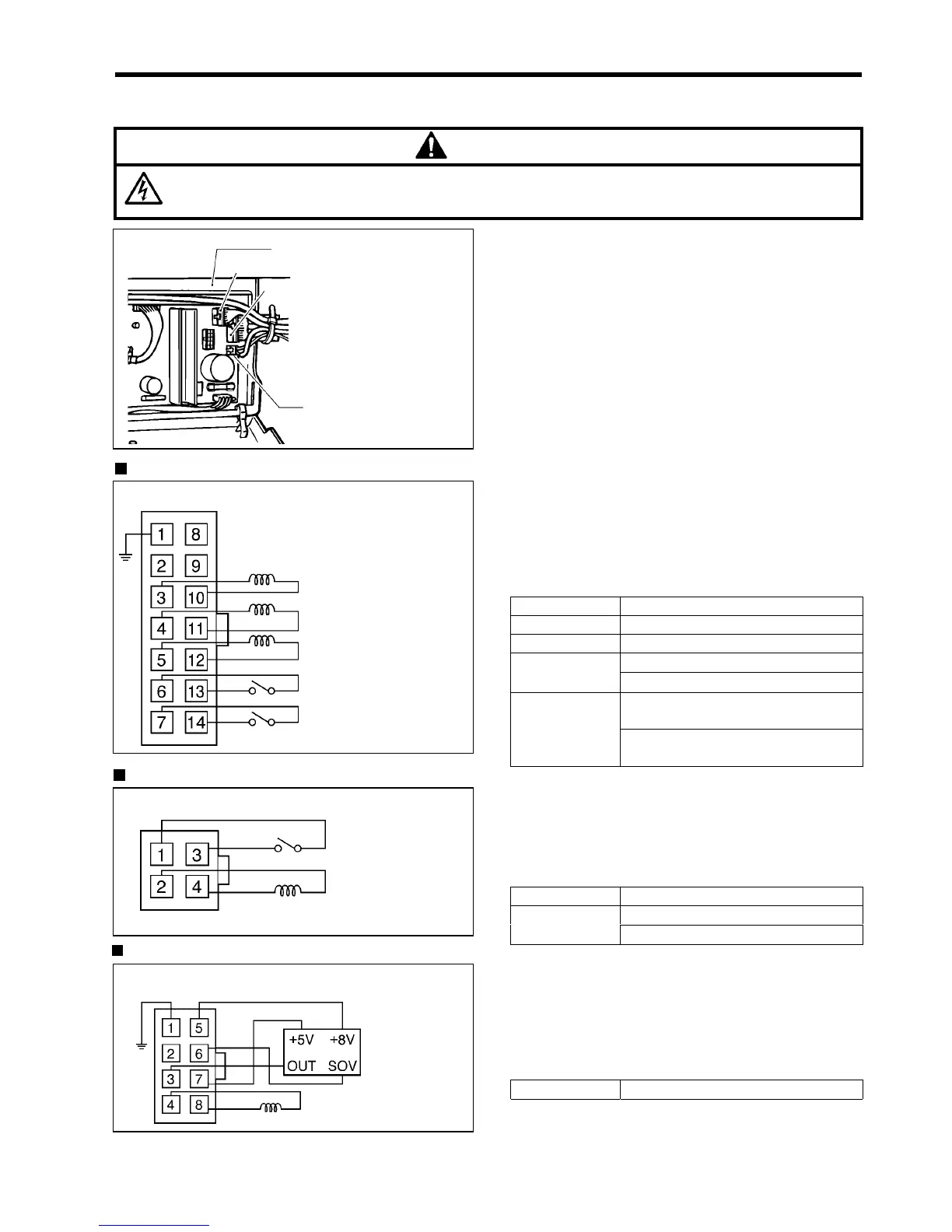
1. Disconnect the sewing machine connector (14P) from
the control box.
2. Measure the resistance of the sewing machine
connector using an ohmmeter in the x1 range.
If the values are as shown in the table below, the
connector is normal.
Between 3 - 4 Thread trimming solenoid: Approx. 7 Ω
Between 4 - 11
Thread wiper solenoid: Approx. 6 Ω
Between 5 - 12
Quick reverse solenoid: Approx. 7 Ω
When actuator is pressed: Approx. 0 Ω
Between 6 - 13
When actuator is released: ∞ Ω
When machine head is upright (switch
ON): 0 Ω
Between 7 - 14
When machine head is tilted back
(switch OFF): ∞ Ω
Solenoid-type presser lifter connector
1. Disconnect the solenoid-type presser lifter connector
(4P) from the control box.
2. Measure the resistance of the solenoid-type presser
lifter connector using an ohmmeter in the x1 range.
If the values are as shown in the table below, the
connector is normal.
Between 2 - 4
Presser lifter solenoid: Approx. 9 Ω
When knee switch is pressed: Approx. 0
Ω
Between 1 - 3
When knee switch is released: ∞ Ω
Lower thread detector
1. Disconnect the lower thread detector connector (8P)
from the control box.
2. Measure the resistance of the lower thread detector
connector using an ohmmeter in the x1 range.
If the value is as shown in the table below, the
connector is normal.
Between 4 - 8
Lower thread solenoid Approx. 12 Ω
Sewing machine connector (14P)
1886M
Thread trimmer solenoid
Thread wiper solenoid
Quick reverse solenoid
Actuator switch
Safety switch
Lower thread detector connector (8P)
1888M
Lower thread solenoid
Solenoid-t



 To Next Page